
Winter Derby Lingfield: Results, Trends and History
Best Horse Racing Betting Sites – Bet on Horse Racing in 2026
Loading...
The Winter Derby’s Return to Its Spiritual Home
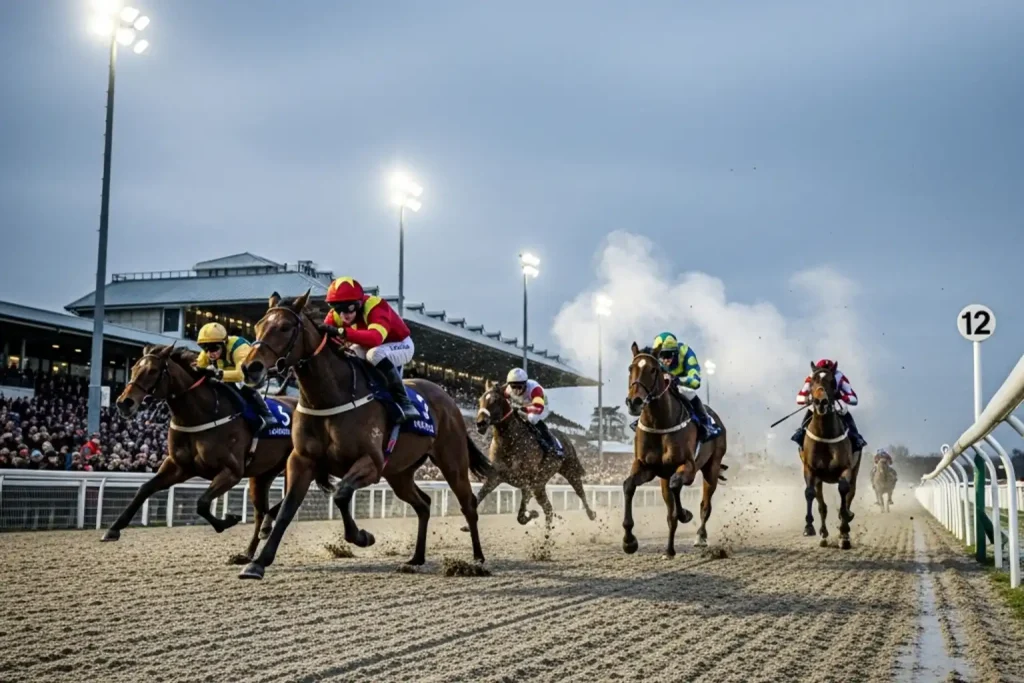
There is a particular kind of racing that only happens when the turf season has gone quiet and the floodlights take over. The Winter Derby at Lingfield Park is the centrepiece of that world — a Group 3 contest over ten furlongs on Polytrack that has, for over two decades, served as the definitive test of all-weather middle-distance talent in Britain. If you follow Winter Derby Lingfield results with any regularity, you already know the race carries more weight than its classification suggests. It draws horses with genuine pattern-race credentials, and the form it produces tends to hold up through the spring.
The 2026 renewal marked something more than a routine Saturday card, though. After two years of exile at Southwell — a consequence of BHA fixture reshuffling — the Winter Derby returned to its spiritual home at Lingfield Park in February. The move mattered. Southwell’s Fibresand surface plays nothing like Lingfield’s Polytrack, and the shift had been felt by trainers, punters and the race’s own identity. Coming back to Surrey restored the conditions under which this race built its reputation: a fair, left-handed track with consistent going, where class usually tells.
This article unpacks the full story of the Winter Derby — from its origins in 1998 through the trends that 23 runnings have produced, into the specifics of the 2026 race and the betting angles the data supports. Where winter crowns are won, the numbers leave a trail worth following.
Winter Derby History: From 1998 to Group 3 Status
The Winter Derby was established in 1998, at a time when all-weather racing in Britain was still finding its footing. Lingfield Park had introduced its original Equitrack all-weather surface only nine years earlier, becoming the first racecourse in the country to offer all-weather racing back in 1989 (the superior Polytrack surface replaced it in 2001). By the late 1990s, the all-weather circuit needed a flagship middle-distance event — something to anchor the winter programme and give top-class horses a reason to stay in training through the cold months. The Winter Derby was the answer.
The race was originally designed as a conditions event over ten furlongs on the Polytrack. It drew respectable fields from the start, though its early years were dominated by horses who happened to stay in work rather than those specifically targeting it. That changed as the race matured. Trainers began mapping campaigns around it, and the quality of runners improved significantly from the mid-2000s onwards.
Group 3 status arrived once the BHA recognised that the Winter Derby was consistently attracting horses rated 100 and above — a threshold that justified pattern-race classification. That upgrade altered the race’s profile. It was no longer just the best all-weather middle-distance contest of the winter; it carried formal black-type recognition, meaning breeders and sales agents paid attention too. A Winter Derby winner could now enhance a pedigree as well as a trainer’s strike rate.
Through the 2000s and 2010s, the race built a quietly impressive roll of honour. Several winners went on to compete at Listed and Group level on turf, which reinforced the idea that the Winter Derby was more than an all-weather event — it was a genuine test of ability. The ten-furlong trip on Lingfield’s tight, left-handed circuit put a premium on tactical speed and the ability to sustain a run from the home turn, making it a race that rewarded class above all else.
Between 2026 and 2026, the Winter Derby was relocated to Southwell as part of a broader reshuffling of the BHA fixture calendar. Southwell’s Fibresand surface — slower, deeper, and less forgiving than Polytrack — produced a fundamentally different race. The winning times were slower, the tactical shape was altered, and there was a feeling among connections that the move diluted the contest. Those two runnings exist as an awkward footnote in the Winter Derby’s history, a reminder that venue and surface are inseparable from a race’s identity.
23 Runnings in Numbers: What the Trends Reveal
Twenty-three runnings is a decent sample. Not enough to build a predictive model you would bet your house on, but more than enough to identify patterns that separate the Winter Derby from a typical Saturday handicap. The data, drawn largely from Geegeez’s trend analysis, paints a picture of a race that strongly favours the market principles and punishes outsiders.
The single most striking trend is this: 17 of the 23 winners finished in the top three of the pre-race betting market. That is a hit rate of nearly 74% for market leaders, which is unusually high for any Group-level contest. It tells you that the Winter Derby is not a race in which form is routinely overturned. The horses that the market thinks will win usually do, or at the very least run close to the money. For punters, this is both a comfort and a constraint — the value tends to be compressed at the top of the market, and finding a live outsider is genuinely difficult.
Draw data adds another layer. Across those 23 renewals, 17 winners were drawn in stall seven or lower. On a left-handed, tight track like Lingfield’s ten-furlong Polytrack configuration — where the field breaks on a bend and needs to settle quickly — a low draw offers a natural positional advantage. Horses drawn wide lose ground on the first turn, and in a race where tactical position from the home turn matters enormously, that early disadvantage is often fatal. The data does not suggest that stalls eight and above cannot win, but the bias is real and persistent enough to factor into any serious form assessment.
Trainer dominance tells its own story. John Gosden has saddled the winner in four of the last seven renewals — a run of consistency that goes beyond chance. Gosden’s approach to the Winter Derby typifies his wider philosophy: target the race with a horse that has shown Group-level ability on a sound surface, ensure it arrives fresh, and trust that class will prevail in a race where the form tends to hold. His runners in this race have generally been well-fancied in the market, which aligns with the broader trend of favourites performing strongly.
Beyond Gosden, the training landscape is relatively dispersed. No other handler has more than two wins, and there is no evidence of a yard that consistently places horses without winning — the kind of “nearly” pattern that might suggest a systematic tactical disadvantage. What the numbers do show is that southern-based trainers, particularly those within easy reach of Lingfield for regular gallops on Polytrack, tend to dominate the entries. Geography matters when the surface is synthetic.
Running style is worth mentioning, though the data here is less conclusive than you might expect. There is a widespread belief that Lingfield’s all-weather track favours hold-up horses — runners who sit in behind and deliver a late challenge. The Winter Derby results partially support this: several recent winners have come from off the pace, timing their runs to hit the front inside the final furlong. But the numbers do not suggest that front-runners are at a hopeless disadvantage. What matters more is the quality of the horse’s finishing effort, regardless of where it sits in the early stages. A horse with a strong turn of foot will nearly always be more dangerous than a pace-setter that merely stays on at one pace.
One final trend: the average starting price of the 23 Winter Derby winners sits at around 5/1. That is not a short-priced favourite’s race, nor is it a longshot graveyard. It suggests a race where the winner usually has solid market support but is not necessarily the outright favourite. The sweet spot for betting, historically, has been the second or third choice in the market — a horse priced between 3/1 and 7/1 with clear form credentials for the conditions.
Winter Derby 2026: Sky Safari, the Southwell Exile, and What Changed
The 2026 Winter Derby was always going to be about more than who crossed the line first. After two years at Southwell, the race’s return to Lingfield Park carried the weight of expectation — from trainers who preferred the Polytrack surface, from punters who wanted familiar form references, and from the racecourse itself, which had lost its signature winter event during the reshuffling.
The answer to the question “did it matter?” came in the result. Sky Safari, trained by James Fanshawe and sent off at 6/1, beat the heavily-backed favourite Chancellor — who went off at 4/6 — in a race that played to Lingfield’s traditional tactical shape. Chancellor, drawn in stall three, was pushed along under two furlongs out and led briefly over 110 yards out, but could not hold off the late surge. Sky Safari, drawn in stall five, was held up in rear before closing up three furlongs out and running on strongly to lead narrowly towards the finish. The patient ride, the ability to sustain a finishing effort on Polytrack — all of it aligned with the historical profile of a Winter Derby winner.
That Chancellor was so strongly fancied — sent off at 4/6 in a field of just five runners — and still could not win tells you something important about the Winter Derby. The market is usually right to identify the most likely winner, but the race’s particular dynamics can undo even the best-laid plans. A horse with a strong finishing kick, race fitness, and the ability to accelerate on a track that rewards speed in the closing stages — these factors can combine to produce a result that looks surprising at first glance but fits neatly within the historical framework.
Ed Arkell, formerly Lingfield Park’s Clerk of the Course, captured the broader trajectory of all-weather racing at the venue when he noted that the quality of horses competing at the top of the AW programme has been “improving year on year” and that “it’s now a day that trainers aim their horses at.” That observation, though made in the context of the All-Weather Championships, applies directly to the Winter Derby. The 2026 field was among the strongest assembled for the race in years, with three runners rated above 105 — a depth that validates the decision to bring the race back to the surface and venue where it belongs.
The Southwell years, in hindsight, served as a control experiment. Strip away the Polytrack, the left-handed bends, and the particular rhythm of Lingfield’s ten-furlong start, and the Winter Derby became a different race entirely. Winning times at Southwell ran several seconds slower than the Lingfield average. The form produced there bore little relation to the 21 previous runnings. Bringing the race back was not nostalgia — it was an acknowledgement that venue and identity cannot be separated.
The return also mattered commercially. The Winter Derby is a key fixture in Sky Sports Racing’s winter schedule, and the broadcaster had indicated that viewership and engagement were higher for Lingfield meetings than for equivalent Southwell cards. The race’s audience, both in the betting ring and on screen, is tied to the venue. Bringing it back to Lingfield was as much a commercial decision as a sporting one.
Betting the Winter Derby: Market, SP and Draw Data
If the trends section gave you the statistical framework, this is where it translates into practical betting. The Winter Derby is not a race that rewards creative thinking — it rewards discipline. The data consistently points to a specific profile, and straying too far from that profile has been a losing strategy over 23 renewals.
Start with starting price. The average SP of Winter Derby winners is approximately 5/1, which places the race in a category where the market is broadly efficient but not perfectly so. Favourites have a strong record — they win more often than the base rate would suggest — but they do not win so often that backing every favourite is profitable. The edge, such as it exists, lies in identifying when a favourite is vulnerable and when the second or third choice in the market has a realistic path to victory.
Field size context matters here. Across British Flat racing in 2026, average field sizes fell to 8.90 runners — a continuation of a multi-year decline tracked by the BHA’s annual racing report. The Winter Derby typically attracts fields of eight to twelve, which is in line with the broader picture for Group-level all-weather racing. Smaller fields compress the market and reduce the likelihood of a shock result, which is consistent with what we see in the data: the winner almost always comes from the head of the betting.
Draw, as discussed, is a significant factor. Stalls one through seven have produced the majority of winners, and the effect is not marginal — it is pronounced enough that a horse drawn eight or wider needs to be significantly classier than its rivals to overcome the positional disadvantage. In practical terms, this means that if you are choosing between two similarly-rated horses, the one with the lower draw should be preferred unless there is a strong reason (pace scenario, proven ability to overcome wide draws) to think otherwise.
The market’s treatment of draw is inconsistent. Bookmakers and exchanges factor in draw to some degree, but the Winter Derby’s market tends to be driven primarily by form and trainer reputation. This creates occasional value when a well-drawn horse at a reasonable price is overlooked in favour of a bigger name drawn wide. Sky Safari’s victory in 2026 at 6/1 was a case in point: the filly had a superb all-weather record (five wins from six AW starts before the race) and a strong finishing turn of foot, trained by James Fanshawe — a handler with a 20% strike rate at Lingfield over five years.
For accumulator and each-way purposes, the Winter Derby sits in an awkward spot. Fields are rarely large enough to trigger generous each-way terms (typically four places are paid at one-fifth odds in fields of twelve or more), and the concentration of winners at the top of the market means that each-way betting on outsiders has historically been a losing proposition. The Geegeez analysis of all-weather betting at Lingfield found that horses seventh or longer in the market produce a significant loss to SP over time — a finding that applies with extra force to a race as formful as this one.
The pragmatic approach, if the historical data is your guide, is to focus on the first three in the market, apply a draw filter, and look for value within that narrow band. It is not an exciting strategy. But over 23 runnings, it is the one the numbers support.
Winter Derby vs Winter Derby Trial: Does the Trial Predict the Main Event?
The Winter Derby Trial, run over the same ten furlongs at Lingfield approximately three weeks before the main event, exists to give connections one final prep run. In theory, it should be the ultimate form guide — same track, same distance, same surface, with the added bonus of race fitness. In practice, the Trial’s predictive value is limited.
Of the 19 runnings where both the Trial and the Winter Derby were staged at Lingfield, only two Trial winners went on to win the main event. That is a strike rate of roughly 10%, which is barely above what you would expect from random chance in fields of this size. The Trial winner, more often than not, either does not run in the Winter Derby at all (connections judging that the race took more out of the horse than anticipated) or runs below expectations on the second occasion.
There are a few plausible explanations for this disconnect. First, the Winter Derby Trial is typically a Listed race, which means the field quality is a step below the main event. Winning the Trial against Listed-level opposition does not guarantee competitiveness against Group 3 rivals. Second, the three-week turnaround is tight. Ten furlongs on Polytrack is a demanding race at any level, and horses that put maximum effort into the Trial may not have fully recovered. Third, and perhaps most importantly, the best Winter Derby contenders often skip the Trial entirely. Trainers like Gosden, who have dominated the Winter Derby, tend to prepare their runners at home or use different prep races, arriving at the Winter Derby fresh rather than battle-hardened.
That said, the Trial is not useless. It provides valuable information about track conditions, pace dynamics, and which horses handle Lingfield’s Polytrack at this trip. A horse that runs well without winning the Trial — finishing a close second or third — may actually be a stronger Winter Derby candidate than the winner, provided it did not have an excessively hard race. The beaten horses from the Trial, particularly those that were value-for-money in defeat, have historically performed better in the Winter Derby than the Trial winners themselves.
The lesson for punters is nuanced. Do not ignore the Winter Derby Trial, but do not take its result at face value either. Treat it as one data point among many — useful for assessing a horse’s comfort on the surface and at the distance, but not a reliable predictor of the main event’s outcome. The Winter Derby’s history shows that fresh horses, targeted specifically at the race, tend to outperform those who come through the Trial route.
Stay Close to the Data
The Winter Derby is one race, but the patterns it produces echo across Lingfield’s entire all-weather programme. Draw biases, trainer angles, surface preferences — they all carry over from one meeting to the next. If you found value in this breakdown, the same analytical approach applies to every card at Lingfield Park, from midweek handicaps to the All-Weather Championships.
Keep checking back for updated results, trend analysis and form data. The numbers do not lie, but they do reward those who look closely enough.