
UK Horse Racing Odds Formats and Implied Probability
 Available in US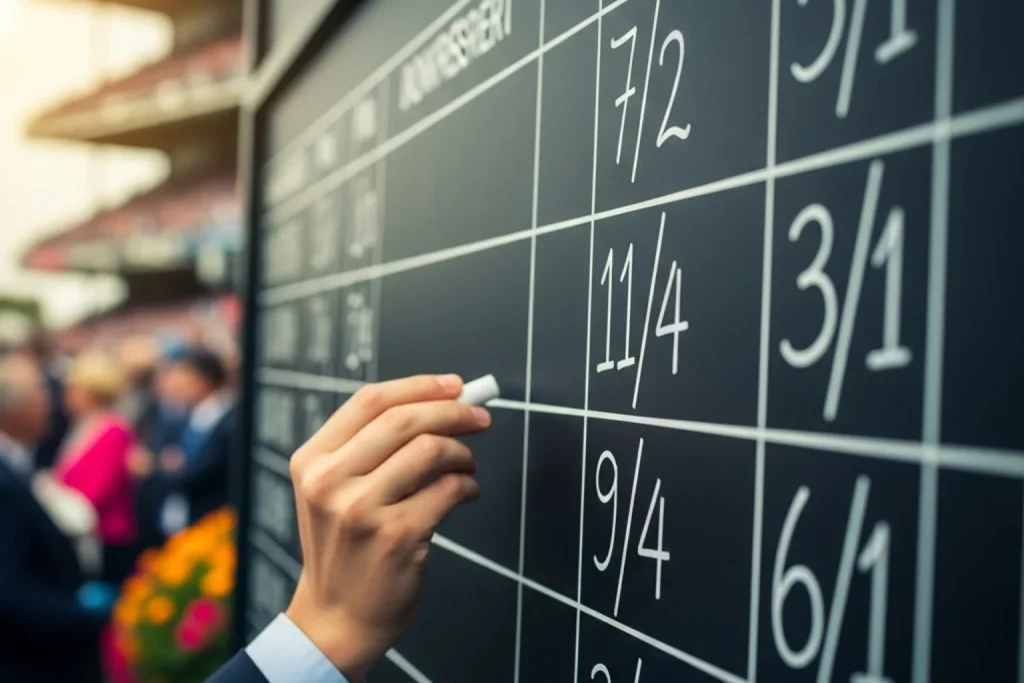
Calculating Implied Probability and UK Horse Racing Odds
Walk into any betting shop or open any online sportsbook, and the first thing you encounter is a list of numbers that the uninitiated find baffling. 5/1. 11/4. 2.50. Evens. These are odds — the market’s assessment of each horse’s chance of winning, expressed as a price. They are not decorative. They are the single most important number on the page for anyone placing a bet, because they determine not just what you might win but what the market thinks about every runner in the race.
In the UK, horse racing odds follow conventions that date back centuries, and the terminology is so embedded in the culture that seasoned punters forget it was ever confusing. For newcomers, though, the formats are a genuine barrier. This guide breaks them down — fractional, decimal, implied probability — and then moves to the practical questions that matter at a course like Lingfield: what is starting price, why do odds move, and where does value live? Read the odds, find the edge.
Odds Formats: Fractional, Decimal and What They Mean
Fractional odds are the traditional British format. A price of 5/1 (spoken as “five to one”) means that for every £1 you stake, you receive £5 in profit if the horse wins, plus your original stake back. A price of 11/4 means £11 profit for every £4 staked. The numerator is the potential profit, the denominator is the stake. Prices shorter than evens — like 4/6 or 1/2 — mean you have to risk more than you stand to win, reflecting a horse the market considers a strong favourite.
Evens (1/1) is the simplest fractional price: you double your money. A £10 bet at evens returns £20 — £10 profit plus your £10 stake. Prices longer than evens — 2/1, 5/1, 10/1, 33/1 — increase the potential return but reflect decreasing confidence from the market. A 33/1 shot is not expected to win, which is why the reward for backing it is so large.
Decimal odds are increasingly common, particularly on exchanges and European-facing platforms. They express the total return including the stake. A decimal price of 6.00 is equivalent to 5/1 — a £1 bet returns £6 total. A price of 2.00 is evens. Decimal odds are mathematically simpler because you just multiply your stake by the price to get the total return. No mental division required.
The bridge between the two formats is implied probability. This is the percentage chance of winning that the odds represent, before the bookmaker’s margin is applied. To calculate it from fractional odds, divide the denominator by the sum of numerator and denominator: at 5/1, that is 1 ÷ (5+1) = 16.7%. For decimal odds, divide 1 by the decimal price: 1 ÷ 6.00 = 16.7%. Implied probability is the tool that turns abstract prices into a tangible question: does this horse have a better chance of winning than the market suggests? If your answer is yes, you may have found value.
Starting Price vs Industry Price: Where the Gap Lives
Starting price — SP — is the official price of a horse at the moment the race begins. It is determined by on-course bookmakers, specifically a panel of SP reporters who record the prevailing odds being offered in the betting ring as the stalls open. SP is the price used to settle bets where no fixed price was taken, which makes it the fallback for anyone who bets without locking in a price beforehand.
The industry price, sometimes called the tissue or forecast price, is the bookmaker’s morning assessment of each horse’s chances. It appears in newspapers and on early-morning markets, and it sets the tone for the day’s trading. By the time the race goes off, the SP may be very different from the morning price — some horses will have shortened (been backed), others will have drifted (not attracted money). The gap between the two tells a story about where the smart money went.
For context, horse racing betting in the UK is not a niche activity. The Gambling Commission reported that gross gambling yield from horse racing (remote betting) reached £766.7 million in the year to March 2026 — second only to football. That volume of money moving through the market means that SPs at well-attended meetings like Lingfield’s feature cards are generally efficient: they reflect a large amount of collective information about each horse’s chances.
Many online bookmakers now offer Best Odds Guaranteed (BOG), which means if you take a fixed price and the SP is higher, you receive the better price. This removes one of the traditional risks of early-price betting and makes SP less relevant for BOG customers — but SP still matters as a measure of how the market valued each runner at the off. Studying SP trends across multiple Lingfield meetings can reveal patterns: which trainers consistently send out horses that shorten, which types of race attract late money, and where the market repeatedly overestimates or underestimates certain profiles.
Odds Movement: Why Prices Drift and Shorten
Odds are not static. Between the opening of the market and the off, prices move — sometimes dramatically. A horse that opens at 10/1 in the morning might go off at 5/1 if it attracts sustained support, or drift to 16/1 if the money goes elsewhere. Understanding why prices move is as important as understanding the prices themselves.
The most common reason for a horse to shorten is straightforward: people are backing it. Money talks, and bookmakers adjust their prices to balance their liability. If a large volume of bets lands on one horse, the bookmaker shortens its price to discourage further backing and lengthens the prices of other runners to attract money elsewhere. This process is continuous from the moment the market opens to the moment the race starts.
Drifters — horses whose prices lengthen — are the mirror image. A horse that drifts may have received negative information (a poor paddock appearance, a change in going it does not like, a rumour of a training setback) or simply failed to attract support. Drifting is not automatically negative — some drifters win — but persistent, heavy drifting from the morning price is generally a warning sign that something has changed.
According to Gambling Commission survey data, roughly 7% of British adults bet on horse racing during the peak spring-summer period, a figure that jumps noticeably around major festivals and meetings. At Lingfield, which runs frequently and attracts a loyal betting audience, odds movement tends to be steadier and less volatile than at the prestige festivals where casual money floods in. That relative stability can work in your favour: market moves at Lingfield are more likely to reflect informed opinion than noise.
The practical skill is simple to state and difficult to master: watch where the money goes, compare SP to morning prices, and build a database of patterns. Over time, you will start to recognise which types of market movement at Lingfield are genuinely predictive and which are just fluctuation. That distinction is the foundation of value betting.
