
What Is Polytrack? Lingfield’s All-Weather Surface Explained
Best Horse Racing Betting Sites – Bet on Horse Racing in 2026
Loading...
The Surface Beneath the Hooves
Every race at Lingfield Park’s all-weather circuit is run on a surface that most racegoers never think about twice. They see the brown-grey strip, hear the muffled thud of hooves, and move on to studying the form. That surface, though, is doing more work than any trainer, jockey or handicapper on the card. It is called Polytrack, and it was engineered to solve problems that plagued horse racing for decades: unpredictable footing, weather-dependent cancellations, and injury rates that troubled the sport’s conscience.
Lingfield was the venue that started it all. When the course laid Britain’s first all-weather track in 1989, synthetic surfaces were experimental. Today, Polytrack is the dominant technology on the UK’s AW circuit, installed at three of the country’s all-weather venues. Understanding what it is made of, why it matters for safety, and how it influences the way races unfold is not optional knowledge for anyone serious about reading Lingfield results. It is foundational. Engineered for consistency — that is the design philosophy, and the racing data backs it up.
Inside Polytrack: Composition and Engineering
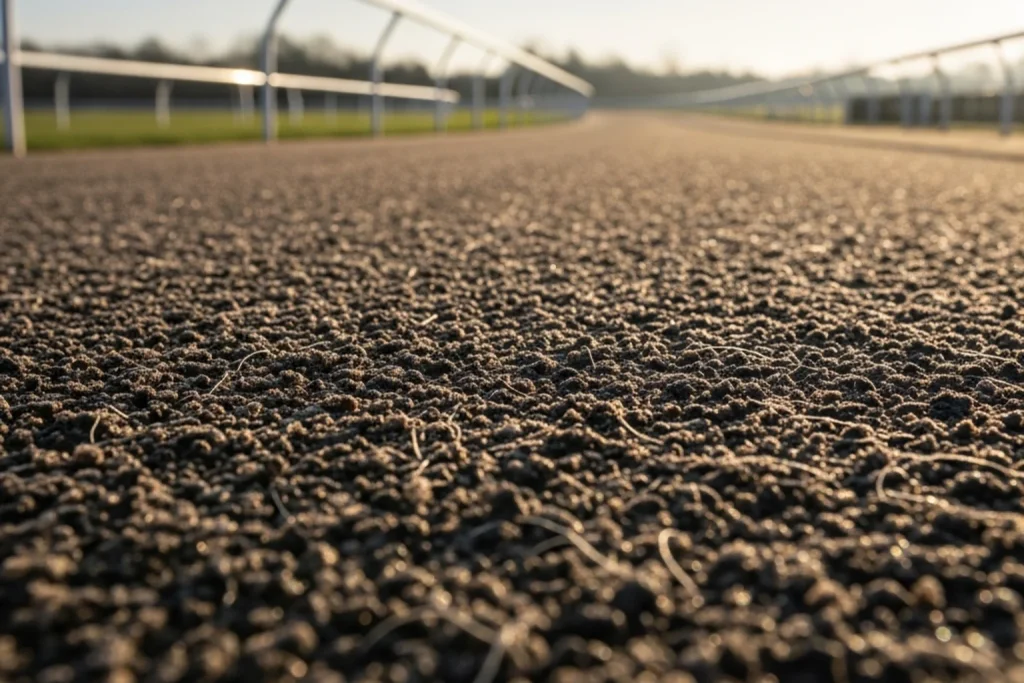
Polytrack is a proprietary surface developed by Martin Collins Enterprises, a company that has been building equestrian surfaces since the 1980s. The basic recipe is deceptively simple: a blend of recycled synthetic fibres, wax-coated quartz sand, and PVC granules. In practice, getting those proportions right — and maintaining them across thousands of race meetings — is anything but simple.
The fibres provide structural integrity. They bind the material together so hooves sink to a consistent depth rather than punching through to a hard base layer or skidding across the top. The quartz sand gives the surface its primary body. It drains efficiently, which is why Polytrack meetings rarely face the waterlogging that turns turf cards into abandonment notices. The wax coating on the sand particles serves a dual purpose: it reduces dust in dry weather and prevents the sand from compacting too tightly in wet conditions. PVC granules add an element of give — a slight cushioning that absorbs concussive force on every stride.
This combination sits on top of a carefully engineered drainage layer, typically a bed of crushed stone that channels water away from the racing surface. The entire structure is designed to feel broadly the same whether it is January or July, raining or dry. That does not mean Polytrack never changes — extreme cold can stiffen the wax element slightly, and prolonged heat can soften it — but the variation is marginal compared to turf, where a week of rain can turn Good to Firm into Heavy. It is this engineered stability that allows Lingfield to schedule meetings through the depth of winter without the constant threat of morning inspections.
In the UK, Polytrack is used at three racecourses: Lingfield Park, Kempton Park, and Chelmsford City. Each installation is maintained by a dedicated grounds team, with the surface harrowed between races and periodically topped up with fresh material. Wolverhampton, Newcastle and Southwell, the other major AW venues, all run on Tapeta — a different synthetic technology with its own characteristics. For anyone studying form across the all-weather circuit, knowing which surface a horse ran on last is as important as knowing whether it ran on Good or Soft turf.
Safety Record: What the Injury Data Shows
The strongest argument for synthetic surfaces has never been about race quality or speed. It has been about what happens to the horses running on them. And on that front, the data is increasingly difficult to argue with.
According to research cited by Pegasus Training Center, injury rates on Polytrack surfaces run approximately 50% lower than on traditional dirt tracks. That is not a marginal improvement. It is the kind of reduction that reshapes veterinary economics, insurance calculations, and — more fundamentally — the welfare conversation around the sport. The cushioning properties of the wax-bound sand absorb impact energy that, on harder or less forgiving surfaces, transmits directly through the horse’s skeletal structure.
The broader picture reinforces the point. Data from the Jockey Club’s Equine Injury Database showed the overall fatal injury rate across all surfaces in North American racing in 2026 fell to 1.11 per 1,000 starts — the lowest figure since tracking began in 2009, a decrease of 44.5% since that first year. Synthetic surfaces specifically recorded a rate of 1.02 per 1,000, outperforming both dirt (1.18) and turf (0.88). As Professor Tim Parkin of the University of Bristol, who has consulted on the EID since its inception, noted: the sustained improvement in these figures is “a credit to all involved in the industry.” In total, 99.89% of all flat racing starts at EID-participating tracks in 2026 were completed without a fatality. The Melbourne Racing Club, which installed Polytrack at its own facility, offered a practical endorsement: the surface, they noted, had “endured very wet conditions and extreme summer temperatures” while presenting an extremely forgiving and consistent surface regardless of climatic conditions.
For Lingfield, this consistency matters doubly. The course runs approximately 80 meetings a year, many of them in the wettest and coldest months when turf racing shuts down across much of the country. Without a surface that can handle sustained use without degrading, Lingfield’s fixture list would be half the size it is. The safety record is not just a moral argument — it is the structural reason the all-weather calendar exists at all.
How Polytrack Shapes Race Results at Lingfield
Predictability is the defining word for Polytrack racing, and it cuts in multiple directions. On the positive side, it means going conditions are almost always reported as Standard or Standard to Slow. There is no equivalent of the dramatic Heavy-to-Good shift that can transform a turf race overnight. Horses that handle the surface tend to handle it reliably, which is why course-and-distance form carries more weight on the all-weather than on turf, where conditions change the question every meeting.
That same predictability, though, creates a specific set of racing characteristics. Polytrack at Lingfield tends to produce true-run races at middle distances. Front-runners are not automatically disadvantaged, and hold-up horses do not have the built-in edge that many casual punters assume — data from DrawBias.com suggests that a genuine hold-up bias exists only at five furlongs on the AW track, debunking one of the most persistent myths about the course. At six, seven furlongs and beyond, pace bias at Lingfield falls squarely in the middle of the AW pack.
Draw bias is another area where the surface levels the field. On Lingfield’s turf course, high draws at five and six furlongs carry an enormous advantage. On the Polytrack circuit, that bias effectively disappears. The surface’s uniform composition means there is no soft rail, no firmer strip, no ground advantage from one side of the track to the other. The result is that stall position on Lingfield’s AW matters far less than jockeyship and the horse’s inherent ability.
For punters working through a Lingfield AW card, the practical takeaway is this: trust the form more than the conditions, weight course experience heavily, and do not assume that tactics which work on turf or on other AW surfaces will transfer directly. Polytrack has its own logic. Learning it is the first step to reading Lingfield results with any real understanding.
Polytrack is more than a surface — it is the reason Lingfield Park can race through winter, the reason the all-weather circuit exists in its current form, and the reason the safety data keeps improving. Knowing what sits beneath the hooves is where any serious analysis of Lingfield results should begin.