
Lingfield Turf Course Guide: Layout, Distances and Going Patterns
Best Horse Racing Betting Sites – Bet on Horse Racing in 2026
Loading...
The Turf Track That Catches Out the Unprepared
Lingfield Park is so closely associated with its Polytrack all-weather surface that the turf course sometimes feels like an afterthought. It is not. The turf track at Lingfield is a tight, left-handed circuit with enough quirks to produce results that confound punters who have not done their homework. Undulations, sharp bends, and a pronounced draw bias at sprint distances make it a course where preparation matters far more than reputation.
The turf programme runs primarily from late spring through early autumn, a compact window that generates a concentrated batch of form. Understanding how the course is configured, what each distance demands, and how the going shifts through the season is essential for anyone trying to read Lingfield turf results with any confidence. Tight turns, sharp form — that is the character of this track, and it rewards those who respect it.
Course Layout and Key Features
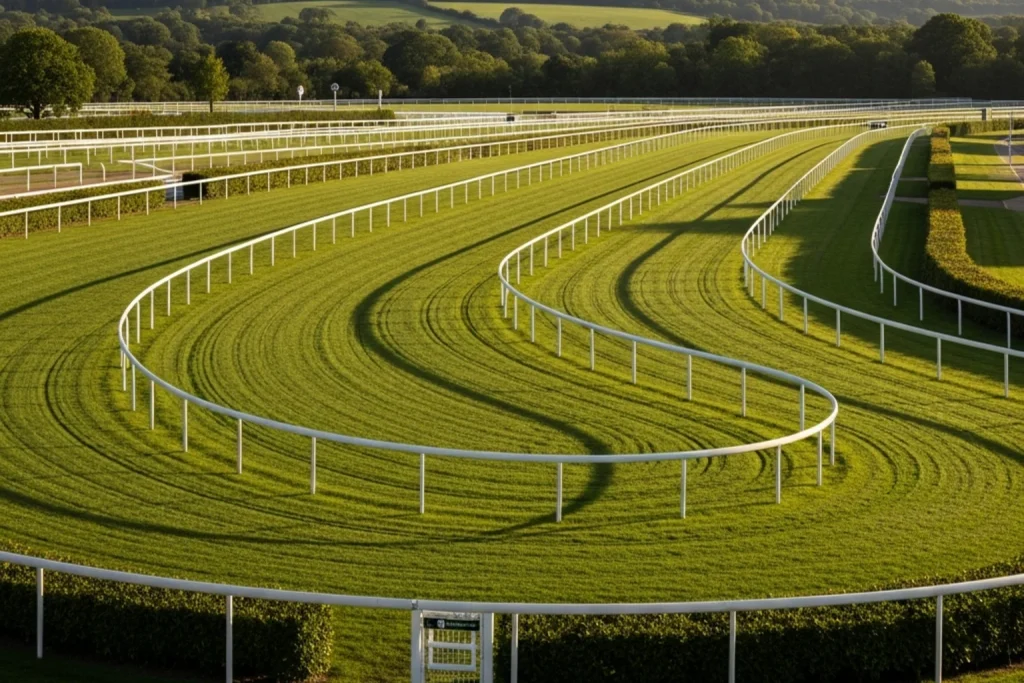
Lingfield Park’s 450-acre estate sits in the Surrey countryside, and the turf course occupies the outer portion of the site, wrapping around the all-weather track that sits inside it. The turf circuit is left-handed, approximately one mile and two furlongs in circumference, and features some notable undulations — a rising section on the far side and a downhill run into the home straight that catches out unbalanced horses.
The bends are the defining feature. They are sharper than at most comparable Flat courses, which means horses that race wide lose significant ground. At sprint distances especially, jockeys fight for the inside rail from the start, and any horse that gets shuffled wide on the turns faces a measurable disadvantage. The home straight is a little under three furlongs, which is short enough that horses making late runs from behind rarely have time to overhaul established leaders unless the pace up front has collapsed entirely.
The undulations add a second tactical layer. The rising ground on the far side demands fitness and stamina — horses that are not genuinely fit will empty climbing the hill and have nothing left for the finish. The downhill run towards the home turn can be treacherous on softer ground, with horses losing their action or getting unbalanced as they negotiate the descent and the turn simultaneously. These are not dramatic inclines — this is Surrey, not Epsom — but they are enough to separate horses that handle the course from those that do not.
For punters, the practical takeaway from the layout is this: Lingfield’s turf course favours agile, well-balanced horses with proven course form. Big, scopey gallopers that thrive on wide, flat tracks like Newbury or Doncaster often find Lingfield’s geometry uncomfortable. Course-and-distance form on this track is a strong positive signal, and the absence of it should prompt caution.
Turf Distances: What Each Trip Demands
Lingfield’s turf course offers distances from five furlongs up to around a mile and a half, though the bulk of the racing is concentrated at the shorter trips. Five furlongs, six furlongs, and seven furlongs are the most commonly programmed distances, reflecting the course’s suitability for speed-oriented Flat racing during the summer months.
The five-furlong sprint is run on a straight section with a slight descent. It is pure speed — no bends to navigate, no tactical complications beyond the start and the finish. Draw becomes the dominant factor at this trip, with high-numbered stalls (toward the stands’ side) historically enjoying a significant advantage. The short distance means any positional disadvantage at the start is almost impossible to recover from.
At six furlongs, the course introduces a left-handed bend into the straight, and the draw influence remains strong. Horses drawn high still benefit from the angle of the track and the natural camber, though the additional furlong does give hold-up runners slightly more time to recover from a slow break. It is a trip that rewards tactical speed — the ability to travel at a high pace without being asked for maximum effort — and horses that can maintain their stride pattern through the turn.
The seven-furlong trip and the mile begin to demand more stamina and tactical awareness. At seven furlongs, the start is further around the bend, and the opening half-furlong is run on a curve. Jockeys need to find a position quickly without burning energy, which places a premium on horses that break cleanly and settle into stride. The mile extends this dynamic, wrapping around the full circuit and testing whether a horse can maintain its rhythm over undulating ground while navigating two bends.
Longer distances — a mile and a quarter and beyond — are less frequently raced on the turf course but feature in select meetings. At these trips, stamina becomes the primary differentiator, and the undulations are felt more acutely. Horses that stay well on flat tracks may find the Lingfield contours add an extra furlong’s worth of energy expenditure to the trip.
Going Patterns: Seasonal Ground and Its Impact
The turf season at Lingfield typically opens in late April or early May, when the ground is often Good to Firm after the spring drying period. Through June and July, the going tends to firm up further, though the groundstaff use watering systems to prevent the surface from becoming dangerously quick. By August and into September, the going can vary sharply depending on summer rainfall — a dry spell will keep the ground on the quick side, while a wet August can produce Good to Soft or even Soft conditions that transform the nature of the racing.
This seasonal variability matters enormously because draw bias at five and six furlongs on Lingfield’s turf track is described as massive in favour of high draws. That bias tends to intensify on firmer ground, where the stands’ rail side of the track offers slightly faster footing. On softer ground, the bias can diminish as conditions become more uniform across the width of the track. Punters who track the going throughout the season and adjust their draw assumptions accordingly gain an edge that static analysis cannot provide.
The Polytrack, by contrast, sits on the other side of the going spectrum entirely: near-constant Standard conditions, rain or shine. This creates a genuine split personality for the venue. Lingfield in February is an all-weather course with predictable conditions. Lingfield in July is a turf venue where the going is the single biggest variable in every race. Treating form from the two surfaces as comparable without adjusting for this distinction is a mistake that even experienced punters make.
For the turf course specifically, the lesson is to check the going before forming any opinion on the card. Ground preferences are deeply embedded in many horses’ profiles — a five-length winner on Good to Firm may be a non-starter on Soft — and at a course as tight and demanding as Lingfield, the margin for error is thinner than at most venues.
Lingfield’s turf course operates on different rules to its all-weather sibling. The draw matters more, the going changes the complexion of every race, and the tight bends demand specific physical qualities from the horses that negotiate them. Understanding those dynamics is the difference between reading turf results at face value and reading them with the context they actually need.