
Lingfield Park History: From 1890 to Modern AW Racing
Best Horse Racing Betting Sites – Bet on Horse Racing in 2026
Loading...
A Racecourse That Reinvented British Racing
Most racecourses in Britain have a founding story. A local landowner, a stretch of flat ground, a group of gentlemen with horses and a shared conviction that racing them against each other was a perfectly reasonable way to spend a Tuesday. Lingfield Park fits that template in its early chapters. What makes it different is what happened a century later, when a quiet Surrey course became the testing ground for a technology that changed the entire sport.
Lingfield’s history spans 136 years. It opened as a turf-only venue in the Victorian era, survived two world wars, adapted through decades of shifting ownership, and then — in 1989 — became Britain’s first racecourse to install an all-weather surface. That decision did not just alter Lingfield. It created a new branch of British racing that now accounts for hundreds of fixtures every winter. 136 years. Three surfaces. One course.
The Victorian Origins: 1890 and the Prince of Wales
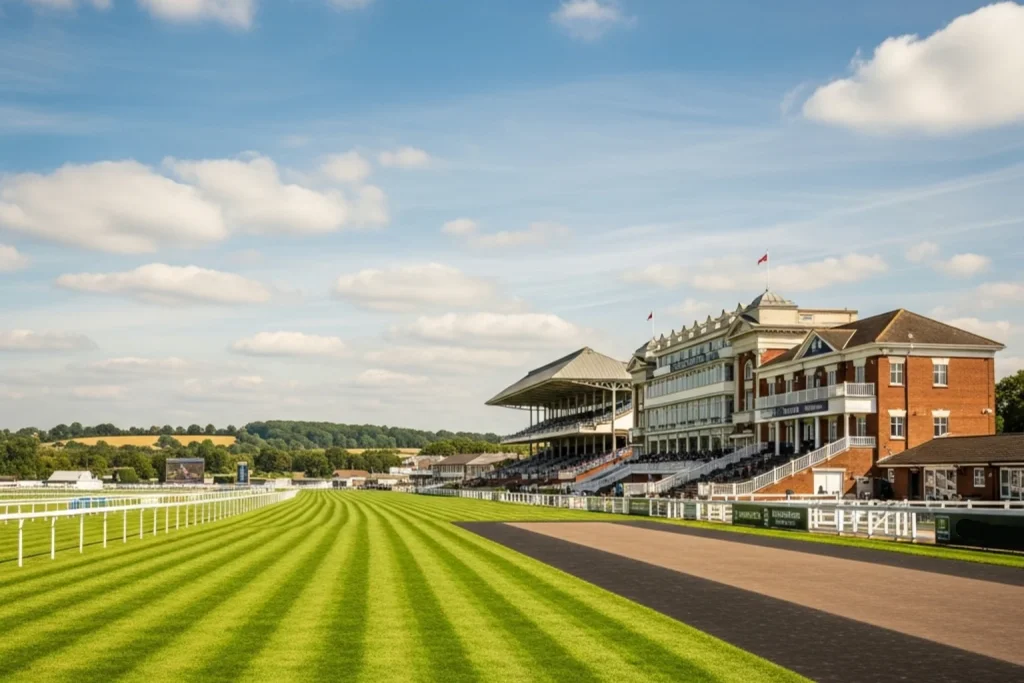
Lingfield Park sits on a 450-acre estate in the Surrey countryside, close to the borders of Sussex and Kent. The racecourse was established in 1890, and its opening was attended by the Prince of Wales — the future King Edward VII — lending the venue an immediate association with the upper tiers of the sport. In an era when new racecourses were springing up across Britain at pace, royal patronage was the fastest route to credibility.
The original layout was a turf-only affair dedicated to jumps racing, making use of the gently undulating Surrey terrain. The Jockey Club granted permission for flat racing in 1894, expanding the course’s scope. Its left-handed configuration and relatively tight turns gave it a distinctive character from the start. It was never Epsom or Ascot — the grandstands were smaller, the prize money more modest — but it established a loyal following among trainers in the south-east, who valued the course for its accessibility from Newmarket and Lambourn and its willingness to stage competitive cards through much of the calendar.
Through the early twentieth century, Lingfield developed a reputation as a versatile venue. It hosted National Hunt racing alongside its Flat programme, and the Derby Trial Stakes — first run in 1932 — gave the course a direct connection to the biggest race in British flat racing. The Trial became a proving ground for Classic hopefuls, a status it still holds today. The course was also requisitioned during the Second World War, when the War Office used the estate as a prisoner-of-war internment camp for Italians, before returning to sport. But for all its steady progress, Lingfield’s first century was broadly typical of a mid-tier English racecourse: respectable, functional, and unremarkable on the national stage.
What separated Lingfield from its contemporaries was not what happened in its first hundred years. It was what happened in its hundred-and-first.
Transformation: 1989 and the Birth of UK All-Weather Racing
In 1989, Lingfield Park did something no British racecourse had done before: it laid an all-weather racing surface. The original installation was Equitrack, an early synthetic material that allowed racing to continue regardless of weather conditions. The logic was straightforward. Every winter, dozens of meetings across Britain were lost to frost, waterlogging, and heavy ground. Trainers had horses ready to run and nowhere to run them. An all-weather track could fill that gap.
The early years were not universally praised. Purists saw all-weather racing as a lesser product — the surfaces were new, the form unreliable, and the racing aesthetically different from the turf traditions the sport was built on. Equitrack itself proved imperfect. It was later replaced by Polytrack, a more advanced synthetic surface developed by Martin Collins Enterprises, which offered better drainage, more consistent footing, and a significantly improved safety profile. The upgrade transformed the product. What had been an experiment became a fixture of the racing calendar.
The ripple effects of Lingfield’s decision spread across the country. Wolverhampton followed with its own all-weather installation, then Kempton Park, then Chelmsford City. Newcastle converted later. Today, Britain has six all-weather venues, but Lingfield remains the original — the course that proved the concept and absorbed the early scepticism so that the others could launch into a more receptive market.
The shift also changed Lingfield’s identity. From a mid-level Surrey course with a modest turf programme, it became one of the busiest venues in Britain, able to race year-round while most turf-only courses sat dormant through December and January. The all-weather calendar, with its concentrated midweek cards and betting-shop audience, gave Lingfield a financial model that few comparable courses could match. Prize funds remained lower than the prestige turf festivals, but the sheer volume of fixtures — week after week, through the dead months of the sport — meant the course could offer trainers a reliable outlet for horses that needed to race. That pipeline of opportunity attracted a loyal stable of professionals who built their winter campaigns around Lingfield’s card.
Lingfield Today: 80 Race Days and Three Formats
Lingfield Park today is operated by Arena Racing Company and stages approximately 80 race days per year, making it one of the hardest-working racecourses in the country. Its unique distinction remains: it is the only venue in Britain that runs all three formats of horse racing — Flat all-weather, Flat turf, and National Hunt jumps. That triple capability is not just a scheduling convenience. It means the course generates a wider variety of form data than any single competitor, and it attracts a broader cross-section of trainers, owners, and horses throughout the year.
The all-weather programme dominates the calendar, running from October through to Easter and beyond. The turf Flat season fills the summer months, typically from May to September. National Hunt fixtures occupy a handful of winter dates, though these are a smaller part of the overall programme. The Winter Derby — now a Group 3 event — returned to Lingfield in 2026 after a brief exile at Southwell, reaffirming the course’s status as the spiritual home of Britain’s premier all-weather race. The All-Weather Championships Vase Day, with its six-race card and prize fund in the hundreds of thousands, further cements Lingfield’s position at the centre of the AW circuit.
Ownership changes over the decades have brought investment in facilities, floodlighting, and improved racing surfaces. The Polytrack was last fully refurbished in recent years and is maintained to exacting standards, with daily harrowing and regular depth-testing. The turf course, while secondary in terms of fixture count, retains its sharp left-handed character and its role as the home of the Derby Trial, a race that has sent nine winners on to Epsom glory.
From a Victorian opening under royal eyes to a twenty-first-century all-weather powerhouse, Lingfield’s trajectory mirrors the evolution of British racing itself: a sport that has repeatedly adapted, sometimes reluctantly, to the demands of a changing industry. The course that took the first risk on synthetic surfaces is still reaping the reward.
Lingfield’s history is not just heritage for a racecourse brochure. It explains why the course races the way it does, why its all-weather form carries the weight it does, and why the Derby Trial in May still draws eyes from Epsom and beyond. Knowing where a racecourse has been sharpens your understanding of what happens there today.