
Lingfield vs Kempton vs Wolverhampton: All-Weather Track Comparison
Best Horse Racing Betting Sites – Bet on Horse Racing in 2026
Loading...
Three Tracks, Three Surfaces, Different Puzzles
The all-weather circuit in Britain is not one homogeneous product. It is a collection of distinct venues, each with its own surface, its own geometry, and its own set of biases that reward certain types of horses and running styles. Treating AW form as interchangeable is one of the most common mistakes punters make — and one of the most costly.
Lingfield, Kempton, and Wolverhampton are the three courses that form the backbone of the winter all-weather programme. They race more frequently than Newcastle or Chelmsford, they attract the largest volume of runners, and between them they produce the majority of AW form that feeds into the All-Weather Championships trail. But they differ in almost every dimension that matters: surface material, track shape, draw influence, and pace profile. Know your track before you back — that is not a slogan, it is a survival strategy for anyone betting the all-weather.
Surface Types: Polytrack, Tapeta and Beyond
The surface is the first and most fundamental difference. Three UK racecourses use Polytrack — Lingfield Park, Kempton Park, and Chelmsford City. Polytrack is a blend of wax-coated quartz sand, recycled synthetic fibres, and PVC granules. It drains efficiently, offers consistent footing across weather conditions, and has a well-documented safety advantage over older surface types. The Melbourne Racing Club, which installed Polytrack at its own training facility, described it as presenting “an extremely forgiving and consistent surface regardless of climatic conditions.”
Wolverhampton runs on Tapeta, a newer synthetic surface developed by Michael Dickinson, the former champion trainer. Tapeta combines sand, wax, and fibres in a different formulation to Polytrack. In practice, it tends to ride slightly faster and firmer, and some observers note it can produce marginally quicker times at sprint distances. The surface was installed at Wolverhampton as a replacement for the original Fibresand, which had a reputation for being deeper and more tiring — a surface that exaggerated stamina and penalised speed horses.
Newcastle, the fifth major AW venue, uses a Tapeta surface installed in 2016. Southwell, the sixth, switched from its original Fibresand to Tapeta in 2021. Each surface creates its own form universe: a horse that handles Polytrack comfortably may not translate to Tapeta, and vice versa. Studying cross-surface form without accounting for this is like comparing turf performances across Good and Heavy going — technically the same sport, practically a different test.
For punters, the practical rule is straightforward: prioritise same-surface form. A horse with three runs on Polytrack at Lingfield has produced more relevant data for its next Lingfield start than a horse with three runs on Tapeta at Wolverhampton, even if the Wolverhampton form looks stronger on paper.
Track Configuration and Pace Characteristics
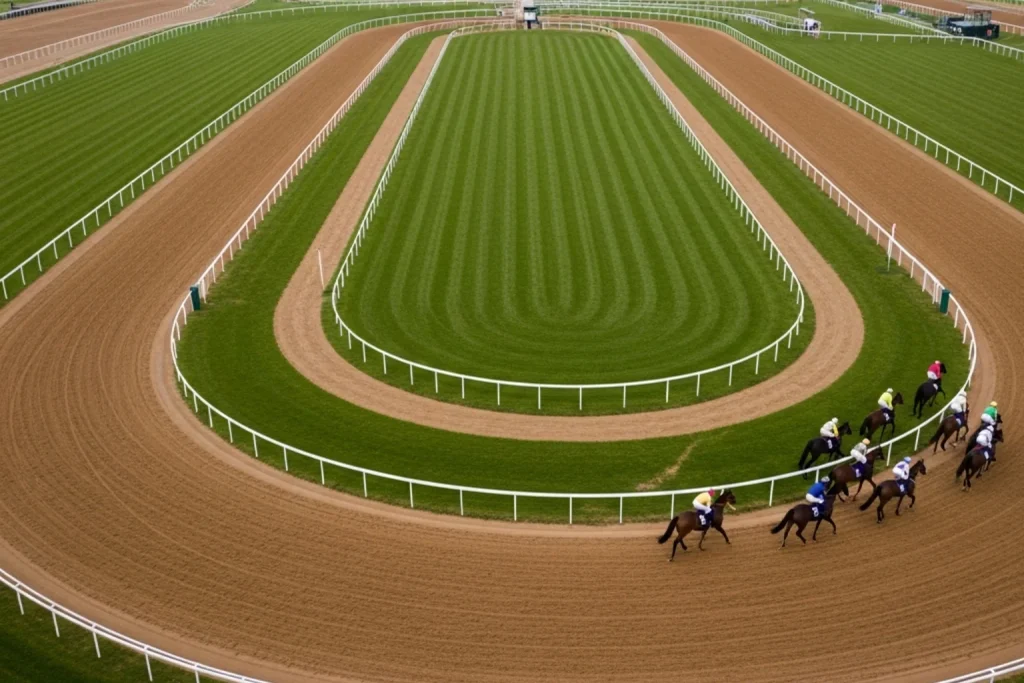
Surface aside, the three courses could hardly be more different in shape. Lingfield’s all-weather track is left-handed, roughly triangular, with a long straight of about three furlongs and relatively sharp bends. The tight turns favour handy, agile horses that can travel on the bridle around the bends without losing momentum. It is not a course for wide runners or horses that need time to wind up — by the time they straighten for home, the leaders often have an unassailable advantage.
Kempton Park is right-handed, virtually flat, and has a more conventional oval shape with sweeping bends and a straight of around three and a half furlongs. The track favours galloping types more than Lingfield does. It is a course where a horse can settle in behind, gradually improve its position on the turns, and produce a sustained finishing effort. The gentler geometry means draw bias is minimal at most distances, and front-runners do not get the same positional benefit they can extract at Lingfield.
Wolverhampton is also left-handed but significantly tighter than Lingfield, with a circumference of barely a mile. It is one of the sharpest tracks in the country. The tight configuration and floodlit evening meetings — a signature of the venue — create a particular set of demands: pace tends to be fierce, positions in the field get compressed around the bends, and stamina at middle distances is tested more aggressively than the trip would suggest on a galloping track. A mile at Wolverhampton is a harder mile than a mile at Kempton.
These configuration differences directly affect pace bias. At Lingfield, the hold-up myth — the idea that the track systematically favours horses ridden from behind — has been debunked by the data: a genuine hold-up advantage exists only at five furlongs. At Kempton, hold-up runners fare well at most distances thanks to the sweeping bends. At Wolverhampton, front-runners that can manage the tight turns often prove hard to catch.
Distance availability also varies. All three courses offer the standard AW range from five furlongs to around a mile and a half, but the way each distance rides differs markedly. Lingfield’s seven furlongs, which starts on a bend, demands a sharp break and early positioning. Kempton’s seven furlongs, starting from a chute, gives runners more time to settle. Wolverhampton’s longer distances feel shortened by the tight turns, since horses expend extra energy maintaining position through the bends. These are not academic distinctions — they directly influence which horses win and which flatter to deceive when switching venues.
Field Sizes and Competitiveness Compared
Field size is the third variable that separates these venues, and it matters more than casual punters tend to realise. Across Flat racing nationally, the average field size in 2026 was 8.90 runners per race, but that number is an aggregate that smooths out significant variation between courses, classes, and meeting types.
Lingfield, as one of the busiest AW venues, generally attracts competitive fields at the lower class levels — Class 5 and Class 6 handicaps regularly draw eight to twelve runners. Its sheer fixture volume (roughly 80 days a year) means there is enough opportunity for trainers to pick and choose, and the course’s proximity to southern training centres in Epsom, Lambourn, and Newmarket ensures a steady supply of runners. At the higher end — Listed and Group races — fields tend to shrink, as the quality filter narrows the eligible pool.
Kempton attracts similar-sized fields in the bread-and-butter classes, though its evening meetings sometimes run slightly smaller cards due to the logistics of transporting horses for floodlit racing. Wolverhampton, being further north and running primarily under floodlights, has historically seen slightly smaller average fields than Lingfield and Kempton, though the Tapeta surface has its own group of specialists who return regularly.
Why does this matter for your analysis? Because field size directly influences result reliability. A horse that wins a twelve-runner race has beaten more opponents and provided stronger evidence of ability than one that wins a four-runner contest. When comparing form across these three venues, adjusting for field strength — not just class level, but actual number of runners — adds a layer of accuracy that separates serious analysis from casual observation.
Lingfield, Kempton, and Wolverhampton each reward a different kind of horse and a different kind of punter. The surface, the geometry, and the field dynamics create three separate form ecosystems under the single banner of all-weather racing. Understanding those differences is the prerequisite for profitable form study across the AW circuit.