
Flat vs National Hunt Racing: Lingfield Track Code Analysis
 Available in US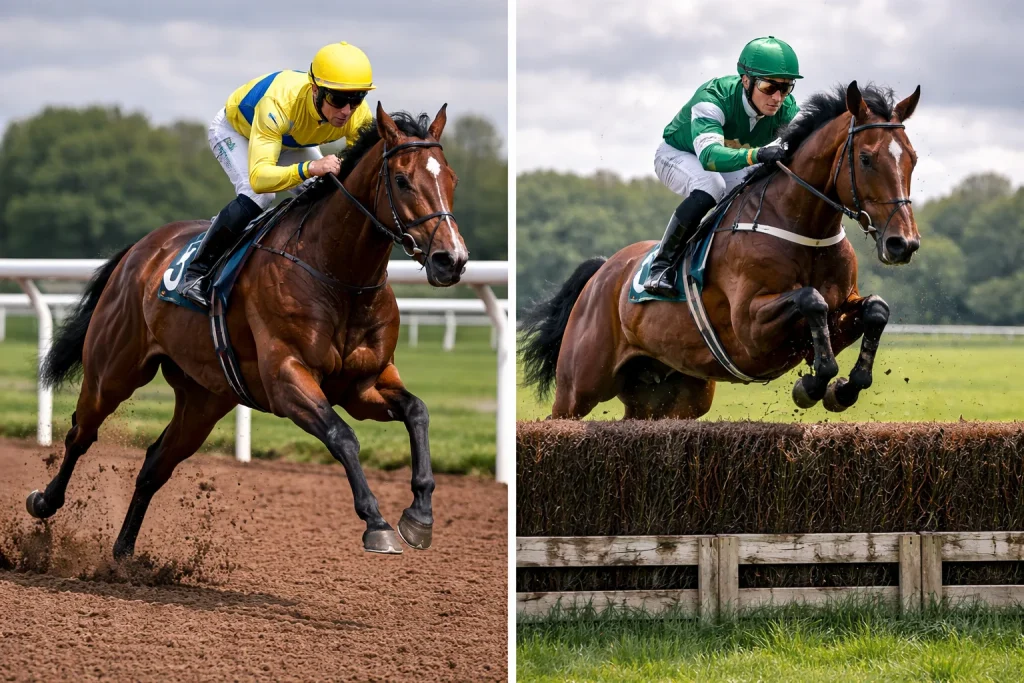
Comparing Flat and National Hunt Racing at Lingfield Park
Lingfield Park is the only racecourse in Britain that stages all three formats of horse racing: Flat on the all-weather Polytrack, Flat on turf, and National Hunt over jumps. That triple-format capability makes it unique in the fixture calendar and gives punters who follow the course closely an unusually broad dataset to work with. But it also means that two fundamentally different sports — Flat racing and jumps racing — share the same venue, and understanding the differences between them is essential for anyone trying to read Lingfield results across the full calendar.
Same gates, different game. The horses are different, the distances are different, the obstacles are different, and the seasonal rhythms are different. This guide lays out the core distinctions for anyone who watches one code and is curious about the other.
Flat vs NH: The Fundamental Differences
Flat racing is run without obstacles. Horses race on level or gently undulating ground from start to finish, and the emphasis is on speed, acceleration, and tactical positioning. Distances range from five furlongs (roughly 1,000 metres) to two miles and beyond, though the majority of Flat races in Britain are between five furlongs and a mile and a half. Jockeys ride with short stirrups in a crouched position, minimising wind resistance and keeping their weight forward over the horse’s centre of gravity.
National Hunt racing — commonly called jumps racing — involves horses clearing obstacles: hurdles (smaller, flexible barriers) or steeplechase fences (larger, solid birch fences that include open ditches and water jumps). Distances are significantly longer, starting at around two miles for hurdles and extending to four miles and beyond for the most extreme steeplechases. Jockeys ride with longer stirrups and a more upright posture, allowing them to support the horse over jumps and adjust balance on landing.
The physical demands are different in almost every dimension. Flat racing is an explosive sport — short bursts of maximum effort, with races lasting between one and four minutes. NH racing is an endurance contest — sustained effort over longer distances, with jumping adding a technical and physical dimension that does not exist on the Flat. A five-furlong sprint at Lingfield lasts under a minute. A three-mile steeplechase lasts closer to six.
Runner Profiles: Who Competes in Each Code
The horses that compete in Flat racing and National Hunt racing are, broadly speaking, different animals — bred for different purposes, built differently, and trained differently.
Flat horses are typically Thoroughbreds bred for speed. They begin their racing careers as two-year-olds, peak between three and five, and many retire to stud or breeding before they turn seven. Their frames are lean and athletic, optimised for aerobic power over short to middle distances. The best Flat horses command extraordinary prices at auction and generate value through their breeding potential as much as their racing ability.
NH horses tend to be larger, more robust animals bred for stamina and jumping ability. Many are by stallions with jump-racing pedigrees, though some Flat-bred horses switch to the jumps later in their careers. NH horses typically begin racing at four or five years old, later than their Flat counterparts, and continue competing well into their teens. The longer career arc means NH horses build deeper form profiles, which makes historical data particularly valuable for punters following the code.
A small number of horses are classified as dual-purpose — capable of competing in both codes. These are rare at the highest levels but more common at the lower tiers, where trainers may run a moderate Flat horse over hurdles to keep it competitive. At Lingfield, you will occasionally see entries that have recent form on both the Polytrack and the jumps course. Recognising when a horse is genuinely dual-purpose and when it is simply being kept busy is one of the subtler skills of form reading at this venue.
Seasonal Calendar: When Each Code Runs at Lingfield
The two codes share the Lingfield calendar but occupy different seasons, with the all-weather programme bridging both.
Flat turf racing at Lingfield runs from approximately late April to early October. This is the summer programme, staged on the outer turf course, and it includes the Derby Trial in May — the course’s most prestigious Flat fixture. The turf card attracts a different profile of horse from the all-weather: horses trained specifically for turf conditions, often with higher ratings and more selective campaigns.
National Hunt racing occupies a handful of winter dates, typically between October and March. These are scheduled around the all-weather programme, which runs year-round but is busiest during the same winter months. The NH fixtures use the turf course configured with hurdles and fences, and the going is usually Soft or Heavy — a stark contrast to the Standard Polytrack that dominates the rest of the winter calendar.
The all-weather programme itself — Flat racing on Polytrack — runs from October through to Easter and beyond, filling the gap when turf-only courses are dormant. This is the backbone of Lingfield’s calendar, generating the bulk of the fixture list and the largest volume of form data. It sits outside the traditional Flat-vs-NH divide because it is Flat racing staged during the jumps season, creating a parallel universe of winter Flat form that has its own specialists, its own trends, and its own market dynamics.
For punters, the practical implication is that Lingfield form needs to be read in seasonal context. A horse’s AW form in January is produced in a different competitive environment from its turf form in July, even though both are Flat racing. And an NH result from a December steeplechase exists in yet another context entirely. Treating all Lingfield results as interchangeable — regardless of surface, code, or season — is one of the most common errors in form study at this uniquely versatile course.
If you prefer winter racing, our detailed breakdown of the National Hunt programme at Lingfield covers everything from hurdle distances to key chase fixtures.
Track the performance of dual-purpose horses by utilizing our comprehensive Lingfield Park results archive.
