
Lingfield Abandoned Races: Causes and UK Refund Policies
 Available in US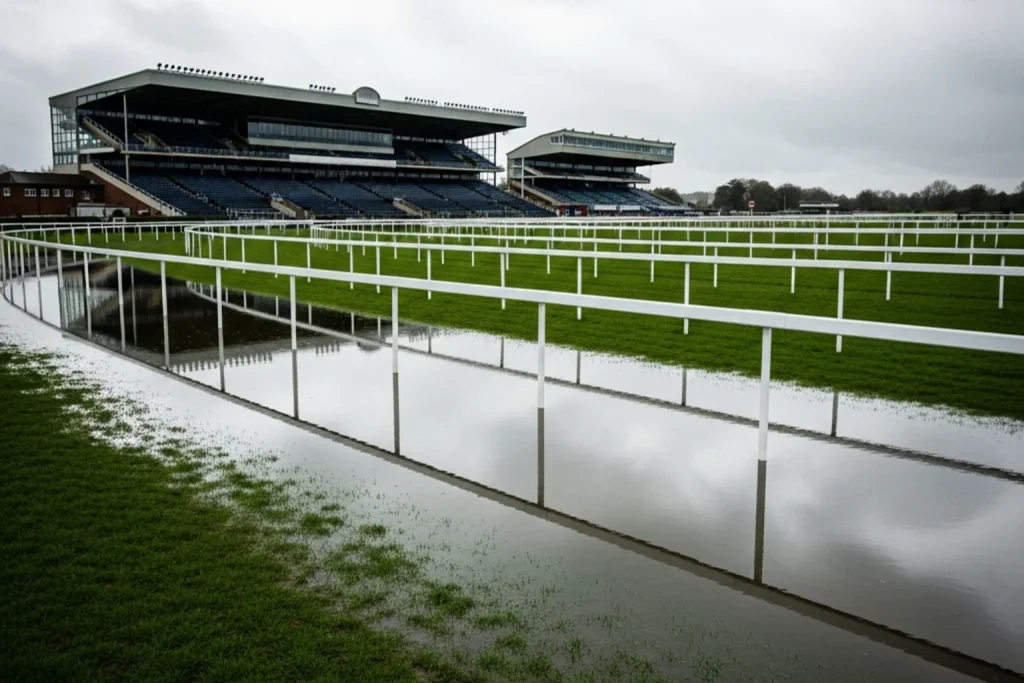
UK Racing Abandonment Policies and Bookmaker Refunds
Racing is an outdoor sport that depends on the ground beneath it. No matter how carefully a fixture list is planned, the weather has the final say. Meetings get abandoned — cancelled before racing starts or cut short after one or two races — and when they do, punters are left with voided bets, disrupted form study, and a gap in the calendar. At Lingfield Park, where the fixture list runs to approximately 80 meeting days per year, abandonments are an occupational hazard rather than an occasional surprise.
The good news is that Lingfield’s dual-surface setup — Polytrack all-weather alongside a turf course — means the course is far more resilient to weather than most. When the flag stays down, there is almost always a reason, and understanding those reasons helps you anticipate cancellations, protect your betting, and adjust your form analysis around the gaps.
Why Lingfield Meetings Get Abandoned
The causes of abandonment split cleanly along Lingfield’s two surfaces. On the turf course, the threats are familiar to any British racecourse: waterlogging after sustained heavy rain, frozen ground during winter cold snaps, and — less commonly — ground that is too firm during prolonged dry spells in summer. A course inspection is typically called when conditions are borderline, with the clerk of the course and BHA officials walking the track to assess whether it is safe and raceable. If the going is judged unsafe — too heavy, too frozen, too hard — the meeting is abandoned.
On the Polytrack, the story is very different. The all-weather surface was engineered to withstand conditions that would shut down a turf track. Polytrack’s manufacturers cite its ability to handle extreme weather, and the Melbourne Racing Club — which uses the surface in Australia — noted that it “endured very wet conditions and extreme summer temperatures in excess of forty degrees Celsius” while remaining “an extremely forgiving and consistent surface regardless of climatic conditions.” At Lingfield, this translates into a dramatically lower abandonment rate on AW cards than on turf cards. The Polytrack drains efficiently, does not freeze easily, and does not become dangerously hard in summer.
That said, Polytrack is not immune. In extreme cold — prolonged sub-zero temperatures that persist for several days — the wax element in the surface can stiffen to a point where racing is deemed unsafe. Snow accumulation can also force an abandonment if it cannot be cleared in time. These events are rare but not unheard of, and they tend to cluster in January and February when the all-weather programme is at its busiest.
There are also non-weather reasons for abandonment, though these are uncommon. A structural issue with the track, a veterinary concern, or a safety problem with the facilities can all lead to a meeting being called off. These are edge cases, but they illustrate that abandonment is not exclusively a weather event.
Historical Pattern of Cancellations
Lingfield’s abandonment history reflects its dual-surface identity. Turf meetings, which occupy a relatively small portion of the calendar (primarily May to September, with a handful of National Hunt dates in winter), account for the majority of weather-related cancellations. A wet summer can wipe out one or two turf cards. A severe winter freeze might claim a jumps fixture. In most years, the turf programme loses at least one meeting to the weather.
The all-weather programme, which dominates the calendar and runs through the months most vulnerable to bad weather, has a remarkably strong record of survival. Lingfield stages roughly 80 meeting days per year, and the overwhelming majority of AW fixtures go ahead as planned. In a typical winter season, the AW calendar might lose one fixture to extreme cold — or none at all. This reliability is one of the fundamental reasons the all-weather circuit exists: trainers, owners, and the betting public can plan around a schedule that almost always delivers.
Across British racing more broadly, the BHA publishes data on meeting abandonments as part of its annual Racing Report. The industry-wide trend is toward fewer cancellations, driven partly by improved drainage at turf courses and partly by the growing proportion of fixtures held on all-weather surfaces. Lingfield’s investment in Polytrack maintenance and its drainage infrastructure contribute to this national trend.
Refunds, Rescheduling and Betting Rules
When a meeting is abandoned before any racing takes place, the betting implications are straightforward: all bets on the abandoned card are void, and stakes are returned. This applies to both on-course and online bets, and there is no ambiguity — if no race has been run, no bets are settled.
When a meeting is abandoned partway through — after one or more races have been completed — the situation is more complex. Bets on races that were completed are settled as normal. Bets on races that were not run are voided and stakes returned. Accumulator bets that include both completed and voided races are settled as a reduced accumulator — the voided leg is removed, and the bet continues with the remaining selections.
Rescheduling varies by meeting. Some abandoned fixtures are rearranged for a later date, while others are simply lost from the calendar. The decision depends on the BHA’s fixture list management, the course’s availability, and the time of year. Feature meetings — the Winter Derby, Vase Day — are more likely to be rescheduled than a standard midweek card, because the commercial and sporting value justifies the administrative effort.
For punters, the key discipline around abandonments is to check the status of any meeting before travelling or placing bets. Course inspections are typically announced the evening before or the morning of a meeting, and the result is published on the BHA website, the racecourse’s own channels, and through bookmaker platforms. Signing up for push notifications from your bookmaker or from a racing results service ensures you receive abandonment alerts in real time rather than discovering a cancellation after the fact.
Ante-post bets — wagers placed days or weeks before the meeting — are the most vulnerable to abandonment risk. Most ante-post bets are non-refundable if the horse does not run, but if the entire meeting is abandoned, different rules apply depending on the bookmaker’s terms. Reading the small print before placing an ante-post wager on a Lingfield fixture is a precaution that takes seconds and can save significant frustration.
