
UK Starting Price (SP) Trends and Racing Odds Market Data
 Available in US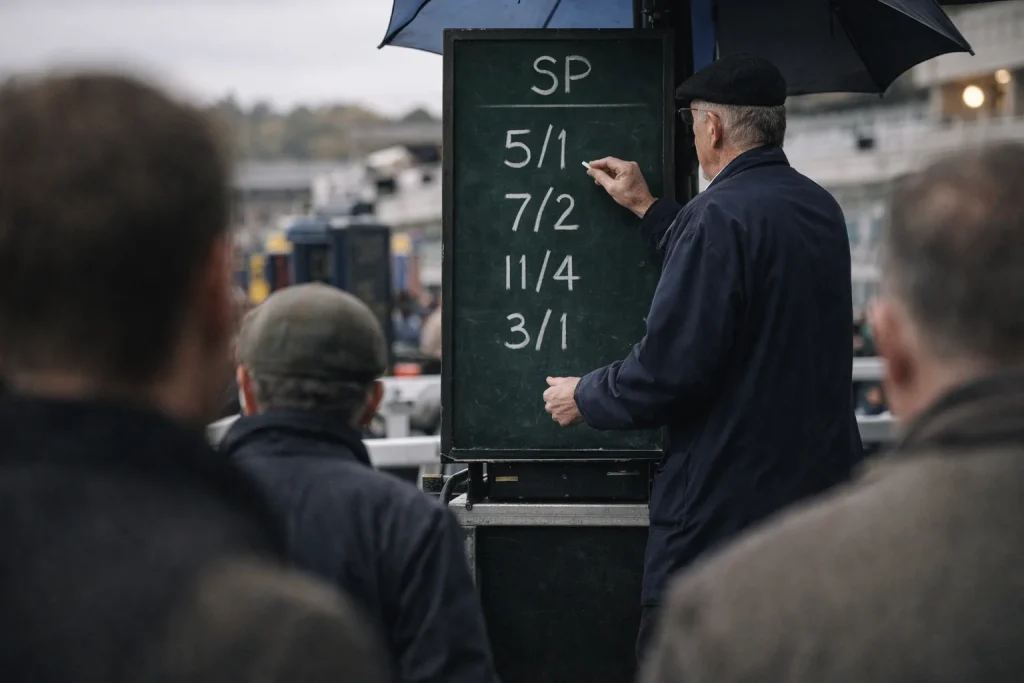
Understanding UK Starting Price Odds and Market Fluctuations
Every horse that runs in a race in Britain is returned at a starting price. It is the number printed in the results, the number used to settle bets when no fixed odds were taken, and the number that historians use to track market trends decades after the race has been forgotten. SP is both a snapshot and a verdict — the market’s final word on each runner’s chance at the moment the stalls opened.
For a concept so central to the sport, starting price is surprisingly poorly understood. Most punters know it exists. Fewer know how it is determined, why it sometimes differs dramatically from exchange prices, or what patterns it reveals at specific courses like Lingfield Park. The price the market settled on — understanding it properly is a prerequisite for serious form study.
How Starting Price Is Determined
Starting price is not set by a computer or an algorithm. It is determined by a panel of independent SP reporters — journalists accredited by the Starting Price Regulatory Commission (SPRC) — who attend every meeting in Britain and record the prices being offered by on-course bookmakers at the moment the race starts. The SP is the median of the best available prices in the on-course betting ring when the starter releases the field.
This process has remained fundamentally the same for decades, even as the betting landscape has shifted dramatically toward online and exchange markets. The on-course ring is now a small fraction of total betting turnover, yet it still determines the official price. This matters because the on-course market can behave differently from the online market — on-course bookmakers adjust their prices based on the money they receive physically, which may not align with the larger volumes flowing through digital platforms.
The UK horse racing betting market generated £766.7 million in gross gambling yield from remote betting alone in the year to March 2026 — second only to football. That enormous volume of money passes through online channels, not on-course betting rings. Yet the starting price, the sport’s official benchmark, is still derived from the comparatively small on-course market. This structural quirk creates opportunities and distortions that informed punters can exploit.
The mechanics are straightforward in principle: the SP reporters note the best price available for each runner at the off, and the returned SP is the consensus of those observations. In practice, thin on-course markets — particularly at smaller meetings — can produce SPs that do not accurately reflect the true weight of money behind each horse. At a major Saturday meeting, the on-course ring is liquid enough for SPs to be broadly efficient. At a midweek Lingfield card, where the on-course attendance may be modest, the SP can diverge from what the online market suggests.
SP vs Exchange Odds: Which Is Better?
The rise of betting exchanges — Betfair being the dominant platform — created a parallel pricing mechanism that often differs from SP. Exchange prices are determined by the collective betting activity of exchange users, who both back and lay horses. The exchange market is typically deeper than the on-course ring and updates continuously up to and sometimes beyond the off.
In general, exchange prices tend to be more efficient than SP for well-traded races. The exchange aggregates more information — more participants, more money, more opinion — and the result is a price that more closely reflects the true probability of each outcome. For favourites, the exchange and SP are usually close. For longer-priced horses, the divergence can be significant: SP may overvalue a horse that the exchange has drifted, or undervalue one that attracted late exchange money.
However, there is a cost to using the exchange: commission. Betfair charges a percentage of net winnings (typically 5% for standard users), which eats into the value of winning bets. An exchange price of 6.0 with 5% commission gives you an effective return of 5.75 — still potentially better than SP, but the margin narrows. For short-priced horses, the commission can make SP the better deal, especially when bookmakers offer Best Odds Guaranteed (BOG), which gives you the higher of your fixed price and the SP at no extra cost.
The practical approach is to compare. Before each race, check the exchange price, the best bookmaker price, and the likely SP. If you are confident in a selection at a price that the exchange and bookmakers broadly agree on, taking the fixed price with BOG gives you the safety net of the SP. If you think the horse will drift (lengthen) before the off, waiting for a better exchange price can be more profitable. The decision depends on the specific race, the specific market, and how liquid the exchange market is for that fixture.
SP Trends at Lingfield Park
Lingfield’s frequent fixture list — roughly 80 meeting days a year — generates a large dataset of SPs that reveal consistent patterns. One of the most striking is the market’s treatment of favourites. Data from trend analysis of the Winter Derby, for instance, shows an average winning SP of 5/1 across 23 runnings, with 17 of 23 winners coming from the top three in the betting. This is a course where the market is right more often than not, and backing outsiders has historically been a losing strategy.
On the all-weather, SPs at Lingfield tend to be relatively tight — fewer extreme outsiders win compared to turf racing at other courses. The Polytrack surface’s consistency means there are fewer going-related upsets, fewer freak results, and a higher conversion rate for well-fancied runners. For SP bettors, this is both a comfort and a warning: the market is efficient enough at Lingfield that finding value at SP requires more precision than at courses where unpredictable conditions create more volatility.
Midweek meetings at Lingfield, where on-course attendance is lighter, can produce slightly wider SP spreads. The thinner on-course market means the SP reporters have fewer bookmakers to survey, and individual bookmaker positions can skew the returned price. Punters who are aware of this can sometimes find value by comparing the SP to the closing exchange price — if the exchange and the SP disagree significantly, the exchange is usually the more accurate reflection of true market sentiment.
Tracking SP patterns over time — which trainers consistently send out horses that shorten from morning price to SP, which types of races produce the biggest SP-to-exchange gaps, which distances see the most favourite-biased results — builds a proprietary database that most punters never bother to compile. At a course with Lingfield’s volume, that database fills up quickly.
