
Lingfield National Hunt Racing: UK Jumps Season Analysis
 Available in US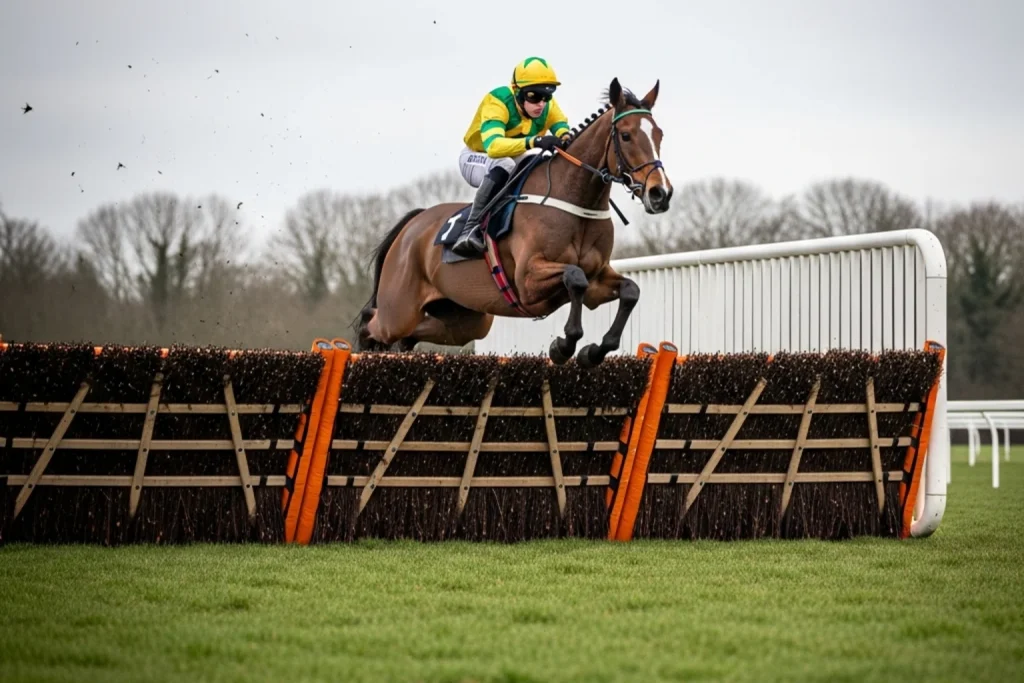
Assessing UK National Hunt Jumps Racing at Lingfield Park
Mention Lingfield Park to most racing fans and they think all-weather. The Polytrack, the Winter Derby, the midweek cards that keep the fixture list ticking through the darkest months. What fewer people realise is that Lingfield also stages National Hunt racing — steeplechases and hurdles over its turf course during the winter — making it one of the most versatile venues in the country.
The jumps programme at Lingfield is modest compared to its all-weather output. It occupies a handful of fixtures between October and March, tucked between the relentless AW schedule. But modest does not mean irrelevant. For punters who follow NH form, and for trainers in the south-east who value a local course with jump facilities, Lingfield’s National Hunt cards offer opportunities that the headline fixtures elsewhere do not. When the jumps flags go up at Lingfield, the course shows a different face entirely.
National Hunt at Lingfield: Programme Overview
Lingfield’s National Hunt programme typically consists of a limited number of winter fixtures, often scheduled on days when the course is not staging all-weather racing. The NH card uses the outer turf course, which is distinct from the inner Polytrack circuit — the same left-handed, undulating turf layout that hosts Flat racing in the summer but configured with hurdle flights and steeplechase fences for the jumps season.
The programme includes both hurdle races and steeplechases, along with occasional National Hunt Flat races (bumpers) for horses at the start of their jumps careers. The quality of the racing tends to sit in the lower to mid tiers of the NH hierarchy — Class 3, Class 4, and Class 5 events that attract southern-trained runners rather than the powerhouse yards of Ireland or the north. This is not Cheltenham or Aintree. It is a working card for working horses, and the punter who treats it as such is better positioned to find value.
The going on Lingfield’s turf course during the jumps season is typically Soft or Heavy, reflecting the winter rainfall that characterises the Surrey climate between November and February. Horses that handle testing ground are essential for any NH card at this course, and form on Good or Good to Firm should be treated with caution when assessing runners for a Lingfield chase or hurdle.
Distances and Obstacles: What Lingfield Offers over Jumps
Lingfield’s jumps course offers distances ranging from about two miles for the shortest hurdle races up to around three miles for the longer steeplechases. The hurdle course features standard portable flights, typically five or six per race depending on the distance. The steeplechase course uses regulation birch fences, including open ditches and water jumps where the configuration allows.
The two-mile hurdle is the most commonly programmed NH distance at Lingfield. It rewards speed and jumping fluency — horses need to be quick enough to maintain a competitive gallop while clearing flights cleanly. Mistakes at the hurdles cost time and momentum, and on a tight course like Lingfield, where the bends come quickly, a horse that loses its rhythm after a jumping error rarely has the space to recover before the next flight.
At two and a half miles and beyond, stamina enters the equation more forcefully. The undulations on Lingfield’s turf course, which are a tactical consideration in Flat racing, become a genuine physical test over jumps distances. The rising ground on the far side saps energy from horses that are already working hard to clear obstacles, and the downhill approach to the home turn demands balance and coordination — qualities that separate safe jumpers from those prone to errors at speed.
Safety remains a central concern across all NH racing. Data from the Jockey Club’s Equine Injury Database showed the fatal injury rate in North American racing reached a record low of 1.11 per 1,000 starts in 2026, with synthetic surfaces recording an even lower 1.02 — figures that reflect sustained investment in course safety, surface engineering, and veterinary care. The steeplechase fences at Lingfield are maintained to BHA standards, and the course’s veterinary facilities are available on every jumps fixture day. While the inherent risk of jumping is higher than Flat racing, the downward trend in injury rates is consistent across the sport.
Key Trends: Trainer and Jockey Angles for Lingfield NH
Because Lingfield’s NH programme is small, the trends that emerge are narrow but exploitable. The same trainers and jockeys appear repeatedly on these cards, and their course form is a more reliable guide than at larger, more contested venues where the competition refreshes constantly.
Southern-based trainers dominate the Lingfield NH entries. Yards within easy reach of Surrey — trainers based in Sussex, Kent, and the south-east generally — provide the bulk of the runners. These trainers know the course, understand the ground conditions, and often have horses specifically suited to Lingfield’s characteristics. A trainer with a strong course record at Lingfield’s NH meetings is a genuine positive signal, more so than a headline name from further afield who may be running a second-string candidate for experience.
Jockey bookings follow a similar pattern. The regular NH riders on the southern circuit tend to partner the Lingfield runners, and their familiarity with the tight bends and the placement of the fences gives them an edge over less experienced visitors. Watching for jockey-trainer combinations that have performed well on previous Lingfield jump cards is a time-efficient way to narrow a field before diving into the form book.
One trend worth tracking is the performance of horses moving between the all-weather and the jumps. Some trainers use the AW programme to keep their NH horses fit during the winter, running them on the Polytrack between jump engagements. These dual-purpose entries can show misleading form if you look only at their AW results without considering that they were essentially using the flat card as a fitness run. The reverse applies too: a horse that runs in an NH race at Lingfield and then reappears on the Polytrack the following week may not have been fully committed in the jump race. Context, as always, is everything.
