
Lingfield Ground Conditions: UK Turf Going and Betting Impact
 Available in US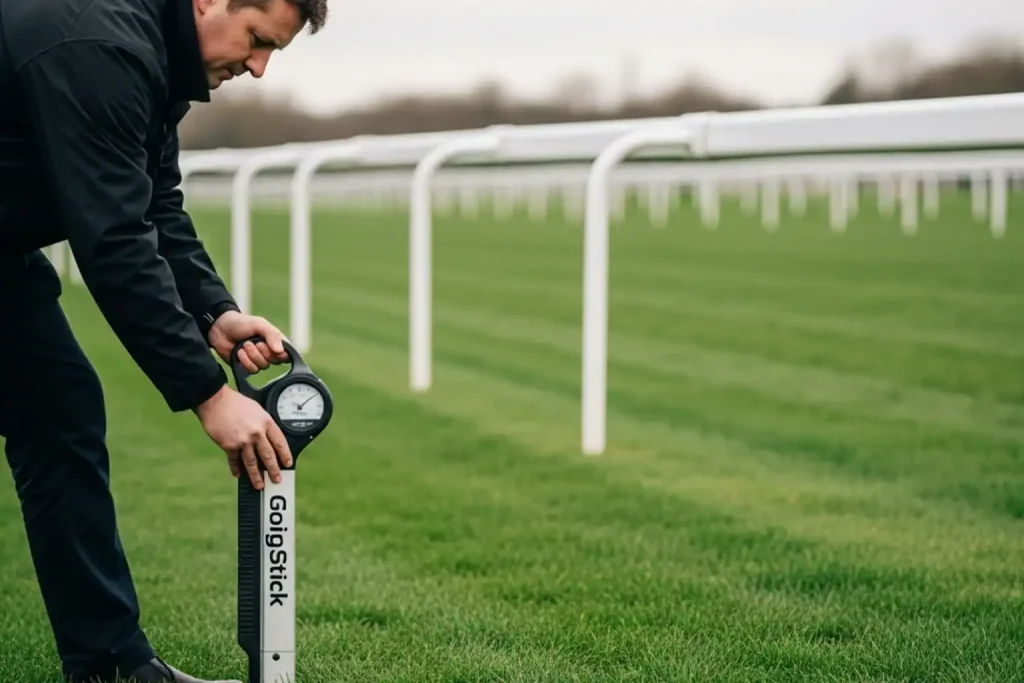
Analysing the Impact of UK Track Going and Ground Conditions
You can study the form all morning, analyse the draw, compare trainer statistics, weigh up the market — and still lose because you ignored the going. Ground conditions are the variable that sits beneath every other piece of analysis, and at most UK racecourses, they change more often than any other factor. A horse that looks like a certainty on Good to Firm becomes a liability on Soft. A plodder on quick ground transforms into a monster when the rain arrives.
At Lingfield Park, the going story is split in two. On the Polytrack all-weather surface, conditions are almost always Standard — the surface was engineered for exactly that consistency. On the turf course, the going fluctuates through the season just as it does at any other UK venue, and its impact on results is profound. The ground beneath the going report — understanding how it is measured, what the descriptions mean, and why it changes the outcome of races — is knowledge that every serious racegoer and punter needs.
The Science of Going: Measurement and Reporting
Going is measured in the UK using a device called the GoingStick, which has largely replaced the older penetrometer. The GoingStick is a mechanical probe inserted into the turf at multiple points across the course, measuring both the amount the ground gives under pressure (penetration) and the force required to move through it laterally (shear). These two readings are combined to produce a numerical value — typically between 2 and 15 — which the clerk of the course translates into the official going description.
Low numbers indicate firm ground. High numbers indicate soft or heavy ground. The translation from number to description is not rigidly standardised — each course has some discretion in how it categorises the readings, which is why experienced racegoers sometimes trust their own assessment of the ground over the official call. But the GoingStick provides a repeatable, measurable baseline that is far more reliable than the older method, which essentially involved a person walking the course and making a subjective judgement.
On synthetic surfaces, the going measurement process is different. Polytrack at Lingfield does not use the GoingStick — the surface’s engineered consistency means it is assessed by the track management team based on maintenance records, weather exposure, and harrowing schedules. Research has shown that Polytrack surfaces reduce injury rates by approximately 50% compared to dirt, and part of that safety advantage comes from the surface’s ability to maintain consistent properties regardless of weather. Where a turf course might shift from Good to Firm in the morning to Good to Soft after a lunchtime shower, Polytrack absorbs the rain and drains it away without changing the way it rides.
Going reports are typically published on the morning of racing and updated as conditions change. On turf fixtures, overnight rain or morning watering can shift the going between the initial report and race time, so checking the latest update before placing a bet is essential.
Going Scale: From Heavy to Firm (and Standard on AW)
The official going scale for turf in British racing runs through seven primary descriptions, from firmest to softest: Hard, Firm, Good to Firm, Good, Good to Soft, Soft, and Heavy. In practice, Hard is almost never declared at UK racecourses — welfare regulations prevent racing on ground that hard — so the effective range runs from Firm to Heavy, with Good as the midpoint that most trainers and horses are comfortable with.
Between these primary descriptions, intermediate calls are common: Good to Firm in places, Good (Good to Firm in places), and similar qualifications that acknowledge the ground is not uniform across the entire course. The rail area, for instance, often rides softer than the middle of the track because it receives more traffic. Fresh ground away from the rail may ride faster. These variations within a single going description can influence jockeys’ positioning and the relative advantage of different draw positions.
On all-weather surfaces, the terminology changes. Polytrack conditions at Lingfield are reported as Standard, Standard to Slow, or Slow. Standard is the default and by far the most common description. Standard to Slow may appear after prolonged cold, when the wax-coated surface stiffens slightly, or after heavy rain, when the surface retains marginally more moisture than usual. Slow is rare. The point is that the entire range of AW going covers a far narrower band of variation than turf — which is the whole design intention.
For a course like Lingfield that races on both surfaces, this creates a dual reality. Summer turf meetings might see the going swing from Good to Firm at the start of a week to Soft by the weekend if rain arrives. The Polytrack surface a few metres away, hosting its own card, will read Standard throughout. Understanding which surface you are looking at — and what the going means in each context — is the most basic prerequisite for interpreting any Lingfield result.
How Going Changes Results at Lingfield
The going affects results at Lingfield differently on each surface, and the distinction is not subtle. On the turf course, the draw bias at five and six furlongs is described as massive in favour of high-numbered stalls, and this bias is amplified on firmer ground. When the going is Good to Firm or Firm, the stands’ side of the track offers fractionally quicker footing, and horses drawn high exploit that advantage to a degree that can override differences in ability. On softer going, the bias can diminish as moisture evens out the surface across the width of the track.
This means the going does not just tell you how fast the ground is — it tells you whether the draw is going to be decisive. A punter who notes that the turf going is Good to Firm and adjusts their assessment of high-drawn horses upward is making a more informed bet than one who ignores the going and focuses exclusively on form figures.
On the Polytrack, the going’s impact on results is marginal by design. The Melbourne Racing Club noted that their Polytrack installation endured extreme conditions — heavy rain and temperatures above forty degrees Celsius — while remaining “an extremely forgiving and consistent surface regardless of climatic conditions.” At Lingfield, the practical consequence is that form on the AW is far more reliable from meeting to meeting than form on turf. A horse that ran well on Standard Polytrack in November is overwhelmingly likely to face the same conditions in February. That reliability makes AW form easier to interpret but also means there are fewer going-related opportunities to exploit — no sudden soft-ground specialists emerging after a downpour, no dramatic reshuffling of the form book after a dry spell.
The going, in summary, is the single biggest contextual variable at Lingfield’s turf meetings and the smallest at its AW meetings. Knowing which scenario you are looking at, and adjusting your analysis accordingly, is where reading the going translates into better reading of the results.
