
Decoding Lingfield Racecards: Entries and UK Form Symbols
 Available in US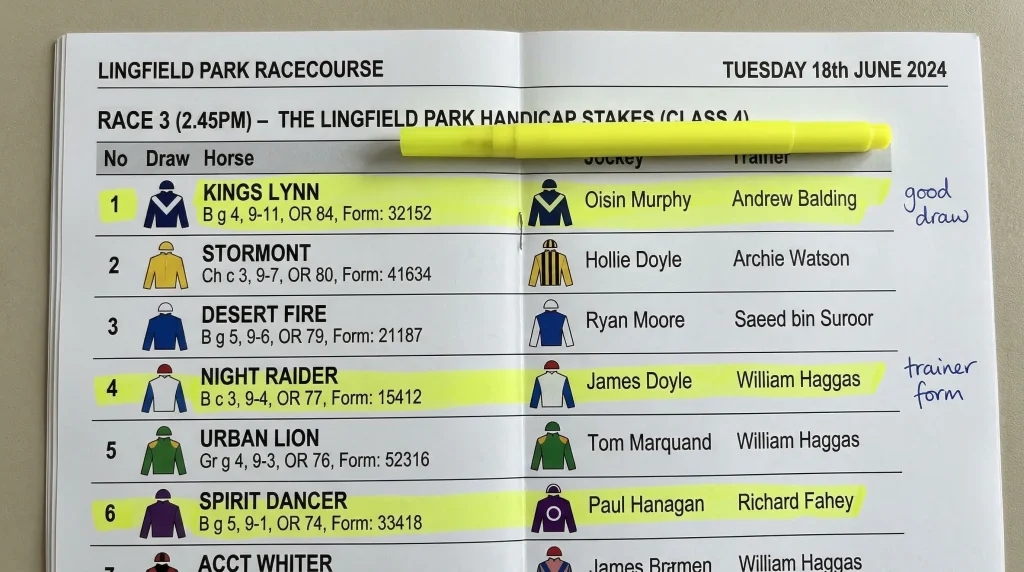
Decoding UK Racecard Form Symbols and Lingfield Entries
Before the horses reach the start, before the betting markets settle, before the commentary begins, there is the racecard. It is the single document that contains everything you need to form an opinion about a race, and it is available hours before the off. Jockeys, trainers, draw positions, weights, form figures, headgear changes, ownership details — all of it sits on one page, waiting to be read.
The problem is that racecards are dense. They pack a remarkable amount of information into a compact format, using abbreviations and conventions that are second nature to regulars but impenetrable to newcomers. At a course like Lingfield Park, where roughly 80 meetings produce hundreds of racecards a year, learning to read the card efficiently is a skill that pays for itself immediately. Read the card, read the race — that principle holds for every meeting and every surface.
Anatomy of a Racecard: Every Field Explained
A standard UK racecard contains, at minimum, the following fields for each horse. Understanding every one of them transforms the card from a data dump into a tactical briefing.
Cloth number and draw. Each horse is assigned a number for identification (the cloth number, worn on the saddlecloth) and a separate draw number indicating which starting stall it will occupy. These are not always the same. The draw matters at Lingfield — particularly on the turf course at sprint distances, where high draws carry a significant advantage. On the Polytrack, draw bias is minimal, but knowing the stall position still helps you visualise how the race might develop.
Horse name, age, and sex. The name is self-explanatory. The age (expressed in years) tells you whether you are looking at a horse in its prime racing years or one at the beginning or end of its career. The sex — colt, filly, gelding, mare — carries implications for long-term racing plans, particularly regarding breeding value.
Silks. The jockey’s colours (silks) identify the owner or ownership group. For regular racegoers, recognising silks helps follow the action in real time. For card readers, silks occasionally reveal connections — different horses running in the same colours are owned by the same person, which may hint at a stable’s priorities for the day.
Form figures. The string of numbers and letters beside the horse’s name is a compressed record of recent finishing positions. The conventions — 1 for a win, 0 for tenth or worse, F for fell, P for pulled up — are explained in detail in the results guide. On the racecard, they give you a snapshot of recent performance before you look any deeper.
Trainer, jockey, and headgear. The trainer and jockey are listed alongside each horse. Headgear notation (b for blinkers, v for visor, t for tongue tie, p for cheekpieces, h for hood) indicates equipment changes. A first-time application of blinkers — shown as “b1” or marked separately — is often a significant signal that a trainer is trying something new to sharpen a horse’s focus.
Non-Runners and How They Change the Race
A racecard is a snapshot taken at declaration time, and by race time it may no longer be accurate. Non-runners — horses withdrawn after the card was printed — are a fact of racing life, and they change the complexion of a race in ways that are easy to underestimate.
The most obvious impact is on the market. When a fancied horse is withdrawn, the remaining runners’ odds shorten to fill the gap, and bookmakers apply Rule 4 deductions to reflect the changed probabilities. The deduction depends on the withdrawn horse’s price: a 6/4 favourite’s withdrawal triggers a heavier deduction than a 25/1 outsider’s. For bettors who placed their wager before the withdrawal, this can significantly reduce the return on a winning bet.
Less obvious but equally important is the tactical impact. A non-runner can remove the expected pace-setter from the field, turning what was projected as a fast-run race into a tactical crawl. It can eliminate the horse that was going to take a specific position on the rail, freeing up space for others. At Lingfield, where over 700 all-weather races are run at seven furlongs alone over a five-year period, the volume of racing means non-runners are a regular occurrence rather than an exception. Keeping an eye on the non-runner lists between declaration and post time is not optional.
Non-runners also affect each-way terms. In races with fewer than five runners, most bookmakers void the place part of each-way bets entirely. In races that drop below eight runners, the place terms may change from three places to two. These shifts can turn a sensible each-way bet into a poor one — or occasionally into a better one, if the removal of a strong contender improves another horse’s place chances.
Racecard Strategy: What to Check First
With all that information on the card, where should you start? The temptation is to read every line for every horse, but in practice, efficient racecard analysis follows a hierarchy. Start with the elements most likely to influence the result, then work downward.
First, check the going and the surface. At Lingfield, this determines which form is relevant. If the race is on Polytrack, focus on all-weather form. If it is on turf, look for turf form — ideally at Lingfield itself, given the course’s quirks.
Second, look at the draw. On the turf course at five and six furlongs, the draw is decisive enough to eliminate certain runners from contention regardless of their ability. On the Polytrack, it matters less, but knowing stall positions still helps you map the likely race shape.
Third, read the form figures. Look for recent winners, consistent placers, and horses whose last run was below expectations (a potential bounce-back candidate). Cross-reference the form with the class of today’s race — a horse dropping in class is often a positive sign, while one stepping up faces a tougher test.
Fourth, check trainer and jockey. Course specialists — trainers and jockeys with high strike rates at Lingfield — deserve extra credit. A combination that wins at a rate above the course average is a meaningful signal, particularly in competitive handicaps where margins are thin.
Finally, scan for headgear changes, equipment notes, and anything unusual. First-time blinkers, a change of jockey from a claiming apprentice to a top professional, or a horse that has been off the track for a significant period — these details sit at the bottom of the hierarchy but can occasionally be the deciding factor. The racecard gives you everything. Your job is to read it in the right order.
