
Reading UK Horse Racing Results: Form Figures and Class Systems
 Available in US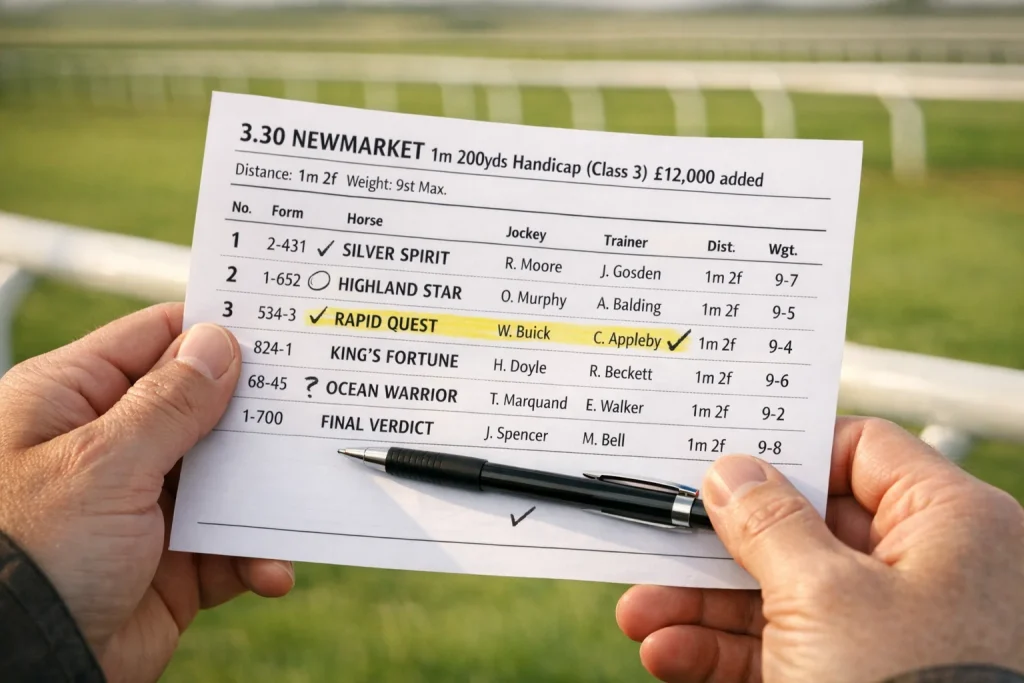
Interpreting UK Horse Racing Results and Class Systems
Open a horse racing results page for the first time and the reaction is almost always the same: a wall of numbers, abbreviations and cryptic shorthand that looks like it was designed to keep outsiders out. Finishing positions sit alongside form strings, starting prices, going descriptions, distance beaten margins, and official ratings. None of it is explained on the page itself. You are simply expected to know.
Here is the reassurance: you are not alone in finding this opaque. According to BHA data, around 68% of racegoers in 2026 were casual or first-time visitors — people who enjoy the spectacle but have never sat down to study what the numbers actually mean. This guide is for them, and for anyone who has stared at a results page and wondered where to start. Every result tells a story — here’s how to read it.
We will use Lingfield Park examples throughout, partly because the course runs roughly 80 meetings a year and generates an enormous volume of results, and partly because its mix of all-weather and turf racing means you will encounter almost every type of result format the sport produces.
Reading the Racecard After the Race
A results page is essentially a racecard with the answers filled in. Before the race, the card tells you who is running. After the race, it tells you what happened. The core fields remain the same, but the post-race version adds several critical columns.
Finishing position is the obvious starting point — the number next to each horse’s name. First, second, third and so on. Simple enough. But the detail matters more. Next to the finishing position you will usually see the distance beaten: how far behind the winner each horse finished, measured in lengths. A head, a neck, half a length, three-quarters of a length, two lengths — these margins tell you whether the result was tight or decisive. A horse beaten a short head ran nearly as well as the winner. A horse beaten twelve lengths was never competitive.
Starting price (SP) appears in the results as a fraction or decimal — 5/1, 11/4, 2.50 — and represents the price returned by on-course bookmakers at the moment the race began. It is the official price used for settling bets when no other price was taken. Next to it, you may see Tote dividends: the pool-based returns for Totewin and Toteplace bets.
Other columns include the horse’s draw number (which stall it started from), its weight carried, the jockey and trainer, and the horse’s official rating at the time of the race. The official rating is assigned by BHA handicappers and determines which class of race the horse can enter. Below the main result, you will often find the race time and a note on the going — the ground conditions.
All of these fields interact. A horse carrying top weight, drawn wide, on going it does not like, finishing third beaten a length — that result reads very differently from a lightly-weighted horse, drawn low, on its preferred ground, finishing third beaten ten lengths. The numbers alone do not tell the story. The context does.
Form Figures Decoded
Form figures are the most condensed piece of information in racing, and they take a moment to learn but a lifetime to master. The string of numbers and letters next to a horse’s name — something like 2130-41 — is a shorthand history of its recent racing career, reading from left to right, oldest to newest.
Each digit represents a finishing position: 1 means the horse won, 2 means second, 3 means third, and so on up to 9. A 0 means the horse finished tenth or worse. Letters carry specific meanings: F means the horse fell, U means it unseated its rider, P means it was pulled up, R means it refused. A hyphen (–) separates the current season’s form from the previous season’s.
So 2130-41 tells you this: last season the horse finished second, first, third, then tenth or worse. This season, it has won its first start and finished fourth in its second. You can already see a pattern — the horse is competitive more often than not, but inconsistent.
The crucial skill is not just reading the sequence but interpreting it in context. A form string of 111 looks exceptional until you discover those wins all came in Class 7 sellers and the horse is now stepping up to Class 4. Conversely, a string of 5640 looks poor until you notice every run was in Group company against the best horses in the country. Form figures are data. The interpretation is where the handicapping begins.
At Lingfield, form figures carry particular weight on the all-weather circuit. Because Polytrack conditions remain relatively stable from meeting to meeting, a horse’s previous performance on the surface is a strong predictor of future performance — far more so than on turf, where going changes can render previous form almost irrelevant.
The Class System: From Class 7 to Group 1
British racing operates a class system that runs from Class 7 at the bottom — the lowest grade of handicap and novice racing — up through to Group 1 at the summit. In between, you have Classes 6 through 2 for handicaps, then Listed races, Group 3, Group 2, and Group 1 for Pattern (non-handicap) races. The higher the class, the better the horses, the larger the prize money, and generally the more competitive the field.
The class system also determines the official rating band for each race. A Class 4 handicap might be restricted to horses rated 0-80, meaning no runner has been assessed by BHA handicappers as better than an 80. A Class 2 handicap might cover 0-105. When you look at a result and see the class designation, you immediately know the quality ceiling of the field.
At Lingfield, the majority of all-weather meetings consist of Class 4 to Class 6 racing, with occasional Class 3 events and the headline races — Winter Derby, the All-Weather Championships — sitting at Group and Listed level. Recognising where a race sits in the hierarchy is the quickest way to calibrate how seriously you should take any single result.
Going Descriptions and What They Mean for Results
Going is the official description of ground conditions. On turf, the scale runs from Hard (extremely firm, rare in the UK) through Firm, Good to Firm, Good, Good to Soft, Soft, and Heavy. On all-weather surfaces like Polytrack, the scale is simpler: Standard, Standard to Slow, or Slow. You will almost never see anything other than Standard at Lingfield’s AW track, which is one of the surface’s primary advantages.
On turf, going changes everything. A horse that cruises through Good to Firm ground may struggle through Soft, and vice versa. Some horses are so ground-dependent that trainers will withdraw them on the morning of a race if the going changes after overnight rain. When you look at a turf result and see the going description, it gives you context for every performance in that race. A horse that finished fifth on Heavy might be a completely different proposition on Good.
Lingfield’s turf course, which hosts a limited summer programme, is subject to the same going variability as any other UK turf venue. Its all-weather track, by contrast, offers near-constant conditions. This distinction matters when you are comparing results across surfaces. A form figure earned on Polytrack in January and a form figure earned on Good to Soft turf in October are not the same currency. Treat them as different datasets, and your reading of Lingfield results will be immediately more accurate.
Going descriptions are typically confirmed on the morning of racing and can be updated after watering or rainfall. They appear at the top of the racecard and again in the full result. If you take one thing from this section, let it be this: always check the going before drawing conclusions from any result. It is the single most important piece of context the results page gives you.
