
All-Weather Championships at Lingfield: Vase Day and UK Finals
 Available in US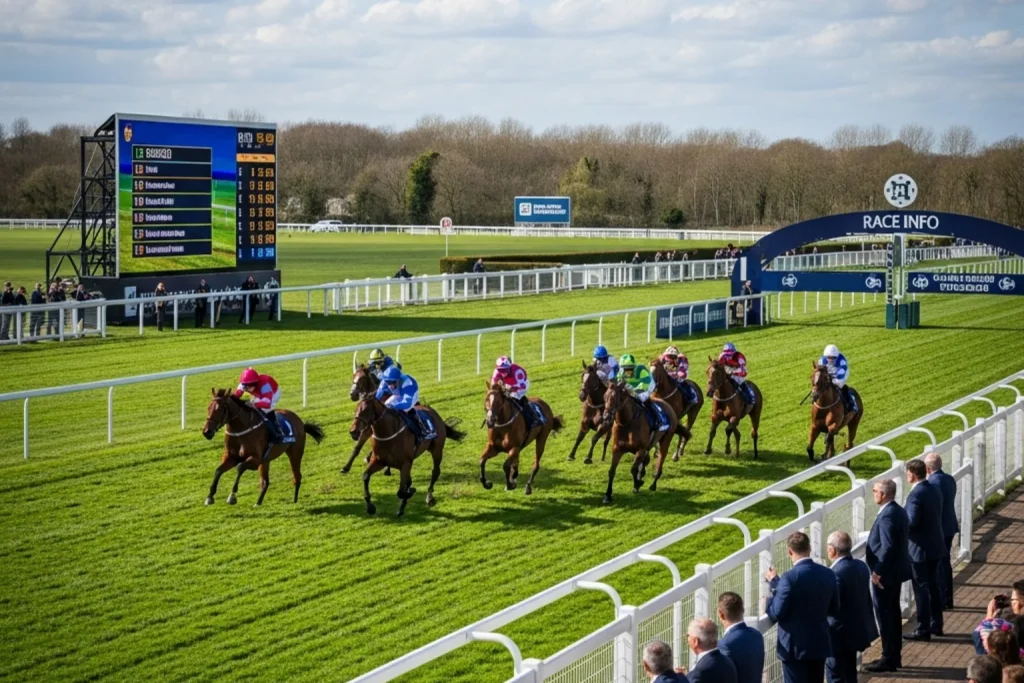
Lingfield Park’s Role in the UK All-Weather Championships
The All-Weather Championships represent the most structured competitive framework in British winter racing, and Lingfield Park sits at its centre. No other venue on the all-weather circuit hosts more championship-qualifying races, more targeted trials, or more significant set-piece events than Lingfield. If you are tracking all-weather form from October through to the spring — following lingfield all weather results across dozens of meetings — you are, in effect, tracking the championship itself.
The championship programme spans the entire AW season, running from October to Good Friday, with qualifying races distributed across four Arena Racing Company venues: Lingfield, Newcastle, Southwell and Wolverhampton. Lingfield’s Polytrack surface and intensive fixture schedule make it the venue where most championship contenders build their campaigns. The culmination comes in two distinct showcase events: Vase Day at Lingfield, worth a combined purse of close to £400,000, and Finals Day at Newcastle, where the prize fund exceeds £1 million.
This guide navigates the full structure of the All-Weather Championships with a focus on what matters for anyone following form at Lingfield — from the seasonal rhythm and qualifying mechanics to the trainers who consistently dominate the trail. Britain’s all-weather proving ground rewards those who understand its architecture.
How the AW Season Works: October to Easter
The all-weather season in Britain does not begin with a fanfare. It starts quietly, usually in late October, when the turf programme begins to thin out and the AW tracks pick up the slack. Lingfield, Kempton, Wolverhampton, Newcastle, Southwell and Chelmsford all race throughout the winter, but only four of those venues — the Arena Racing Company tracks of Lingfield, Newcastle, Southwell and Wolverhampton — host championship-qualifying races. Kempton and Chelmsford run their own all-weather programmes, but their races do not feed into the ARC-administered championship structure.
The season runs through to Good Friday, which marks Finals Day at Newcastle. Between those bookends — late October to mid-April — the championship programme quietly accumulates. There is no fixed number of qualifying races per week; the schedule depends on the fixture list published by the BHA and the race planning decisions made by each venue. What is consistent is the volume of racing at Lingfield. With approximately 80 race days per year spread across Flat AW, Flat Turf and National Hunt, Lingfield’s calendar is one of the busiest in the country. During the core AW months — November through March — the venue typically races two or three times per week, producing a steady stream of form for anyone tracking championship contenders.
The qualifying mechanism is built around categories. The championships are divided into divisions — sprint, mile, middle distance, staying, fillies and mares — and horses accumulate points based on their finishing positions in designated qualifying races. The categories mirror the traditional distance-based structure of Flat racing: sprinters over five and six furlongs, milers, ten-furlong horses, and stayers over twelve furlongs and beyond. There is also a separate fillies and mares division, which runs across all distances.
For punters, the seasonal rhythm creates a recognisable pattern. The early months (October to December) tend to produce lower-quality championship races, as many of the better horses are still completing their turf campaigns or returning from a break. From January onwards, the quality sharpens. Trainers begin targeting specific championship categories, and the form becomes more reliable. By February and March, the picture is clearer — the leading contenders in each division are identifiable, and the championship narrative has enough data to support informed betting decisions.
The AW season also intersects with the turf calendar in ways that affect form interpretation. Some horses compete on both surfaces, particularly in the autumn and spring, and their all-weather form needs to be assessed in context. A horse that ran poorly on soft turf in November may transform on Polytrack in January — not because it has improved, but because the surface suits it better. Understanding this crossover is essential for anyone trying to make sense of lingfield all weather results during the transitional months.
Vase Day at Lingfield: Six Races, One Showcase
The All-Weather Champions Vase Day is Lingfield’s marquee championship fixture — six races with a combined prize fund of £395,000, staged on a single card that serves as the penultimate act of the AW season before Finals Day. It is, in terms of prize money and field quality, the richest day of all-weather racing that Lingfield hosts in any given year.
The card is structured around the championship categories. Each of the six races corresponds to one of the main divisions — sprint, mile, middle distance, staying, and fillies and mares — with an additional open handicap that often attracts a deep, competitive field. The Vase races are not Group races in the formal pattern sense; they carry Listed or conditions race status. But the prize money and the championship points on offer mean they attract runners of genuine quality, and the form produced on Vase Day frequently franks well at higher levels later in the season.
Ed Arkell, formerly Lingfield Park’s Clerk of the Course, has observed that the quality of horses competing on the top AW days has been “improving year on year” and that it has become “a day that trainers aim their horses at.” That trajectory is visible in the fields. A decade ago, Vase Day attracted solid handicappers and the occasional Listed-class performer. Now, the sprint and mile events regularly feature horses rated 105 and above — the kind of rating that would make them competitive in Group races on turf. The middle-distance event, run over ten furlongs on Polytrack, often serves as a de facto Winter Derby prep, with some runners using it as a stepping stone to that Group 3 contest.
For punters, Vase Day presents a specific challenge. The fields are generally smaller than average handicaps — typically seven to ten runners — which compresses the market and makes outsiders less viable. The form tends to be strong and exposed, because the horses that contest these races have usually accumulated enough championship runs to generate a clear picture of their ability on the surface. This is not a card for speculative punting; it rewards homework and an understanding of which horses have been pointed at these races specifically.
Tactically, the Vase Day races tend to be run at a genuine pace. The prize money incentivises aggressive riding, and the championship points system means that placed efforts carry real value — a horse that finishes second or third still earns significant points toward the Finals Day qualifications. This changes the complexion of the racing: jockeys are less inclined to sit and wait, because running on for a place has tangible rewards. The result is often a true test of ability, with fewer tactical races and more straightforward form to interpret.
The timing of Vase Day — on Good Friday, the same date as Finals Day at Newcastle — positions it as the climax of the championship season at Lingfield. The Vase was inaugurated in 2022 and has quickly become a fixture that trainers target as the culmination of their AW campaigns. The leading contenders in each division have emerged by this stage, and Vase Day either confirms or disrupts the standings. A horse that wins impressively on Vase Day rounds off its championship season on a high. It is, in effect, the alternative finale of the AW season — and at Lingfield, on Polytrack, it plays to the strengths of horses that handle this particular surface best.
Finals Day at Newcastle: and European Ambition
If Vase Day is Lingfield’s championship finale, Finals Day at Newcastle is the top-tier showpiece. Staged on Good Friday — a date chosen for its high visibility in the racing calendar and its proximity to the start of the turf Flat season — Finals Day carries a total prize fund exceeding £1 million, making it the richest day of all-weather racing in Europe. The switch to Newcastle, which races on Tapeta rather than Polytrack, adds a surface variable that tests the versatility of championship contenders.
The card mirrors the championship structure: sprint, mile, middle distance, staying, and fillies and mares finals, plus a supporting handicap. Each final brings together the highest-ranked horses in its division, based on points accumulated throughout the qualifying season. The sprint final, run over six furlongs, tends to attract the largest field and produces the most competitive betting market. The staying final, over two miles, is often the smallest field but the most tactically intriguing, given the scarcity of high-quality AW stayers.
Newcastle’s Tapeta surface behaves differently to Lingfield’s Polytrack. It is generally considered faster and less forgiving of horses that need to be covered up in the early stages. Horses that have built their championship campaigns primarily at Lingfield sometimes struggle to transfer their form to the Tapeta — a pattern that creates opportunities for punters who track surface preferences closely. The best Finals Day contenders tend to have proven form on both Polytrack and Tapeta, or at minimum have demonstrated the ability to handle a quick surface that plays more like fast ground on turf.
The European ambition behind Finals Day is real but still developing. The organisers have positioned it as a rival to similar showcase events in France and Dubai, though the prize money remains below the levels offered at Meydan for the Dubai World Cup carnival. What Finals Day does offer, and what those events often lack, is a structured championship pathway — the winners have earned their place through a full season of competition, rather than being invited on reputation. This gives Finals Day a narrative depth that one-off invitation races cannot match.
For anyone who has been following form at Lingfield throughout the winter, Finals Day is where that homework pays off. The horses that dominated Vase Day, that ran consistently through the qualifying months, that handled Lingfield’s Polytrack with authority — those are the ones best positioned for Newcastle. The surface change introduces uncertainty, but the form spine remains. A horse that has been the best in its division on the AW circuit all winter is still the most likely winner, even if the track plays a little differently on the day.
ARC Bonus Scheme: How Horses Qualify
Running alongside the championship itself is the ARC £1,000,000 All-Weather Bonus Scheme — a separate incentive structure administered by Arena Racing Company that adds a substantial financial layer to the AW season. The scheme distributes up to £1 million in bonus payments across the qualifying period, with the headline award of £100,000 going to the “Horse of the Year” — the horse that accumulates the most points across qualifying starts at ARC’s four all-weather venues.
The mechanics are straightforward in principle, though the detail matters. Horses earn points based on finishing position in designated bonus-qualifying races at Lingfield, Newcastle, Southwell and Wolverhampton. A maximum of 15 qualifying starts count toward the bonus total, which prevents a horse from gaming the system through sheer volume — running 30 times in low-grade races would not, on its own, be enough to claim the top prize. Quality of performance matters as much as frequency.
Points are weighted by race class. A win in a Class 2 handicap at Lingfield earns more points than a win in a Class 5 at Southwell, which reflects the higher level of competition and the assumption that the horse has beaten better opposition. Placed efforts also earn points, though at a reduced rate. This weighting system means that serious championship contenders need to win at a reasonable level, not simply turn up and finish in the frame of weak contests.
The bonus scheme has had a measurable effect on training patterns. Since its introduction, there has been a noticeable increase in the number of horses making return trips to ARC venues during the AW season. Trainers who might previously have given a horse one or two winter outings now have a financial incentive to keep them active through the season — the possibility of a five- or six-figure bonus payment justifies the additional entries and travel costs. For owners, particularly those with moderate-quality horses that might not earn significant prize money from individual races, the bonus scheme provides a reason to keep a horse in training over the winter rather than turning it out.
From a form perspective, the bonus scheme introduces a layer of interpretation that punters need to account for. A horse making its twelfth or thirteenth qualifying start may be running as much for bonus points as for prize money on the day. This does not mean the horse is not trying to win — connections always want to win — but it does mean that the decision to run in a particular race may be influenced by the bonus standings rather than the race conditions. A horse with ten points from 14 starts might enter a modest Lingfield handicap specifically to secure a placed finish and edge closer to a bonus threshold, even if the race is slightly below its class level.
The Horse of the Year award has typically been won by a horse with a consistent rather than spectacular record: multiple wins and places across a range of ARC venues, with Lingfield and Wolverhampton usually providing the bulk of the qualifying starts due to their intensive fixture schedules. The winners tend to be versatile types that handle both Polytrack and Fibresand, which gives them access to qualifying races at all four venues. A horse that only runs well on Polytrack limits itself to Lingfield and Chelmsford — and since Chelmsford is not an ARC venue, that effectively means Lingfield alone for qualifying purposes.
The scheme also creates a secondary market of interest for punters who follow the bonus standings. As the season progresses, the leaderboard narrows, and the remaining qualifying races for the top contenders become identifiable. Backing a horse that needs a placed finish to secure a bonus payout can offer an angle that the wider market does not fully price in — particularly in low-profile midweek races where the horse’s bonus motivation may not be widely appreciated.
Trainer Angles: Who Dominates the AW Championship Trail?
The all-weather championship trail rewards volume, consistency and surface knowledge — qualities that tend to concentrate in a relatively small number of training operations. While any licensed trainer can enter horses in qualifying races, the championship standings have historically been dominated by yards with specific AW expertise and geographic proximity to the key venues.
Lingfield’s status as one of the busiest racecourses in Britain — hosting approximately 80 race days a year across its three racing formats — makes it the natural base for championship campaigns. Trainers in Surrey, Sussex and Kent have the easiest access, and that logistical advantage shows in the entry patterns. The yards that consistently feature in the Lingfield results pages through the winter months are the same ones that tend to lead the championship standings by February.
A handful of names recur with striking regularity. Without naming a single “champion trainer” — the landscape shifts from year to year — the pattern is that large, well-resourced operations with dedicated all-weather strings tend to dominate. These are yards that treat the AW season as a distinct campaign rather than a holding pattern between turf seasons. They plan entries around championship qualifying races, manage their horses’ schedules to maximise bonus points, and make tactical decisions about which venue and distance to target for each horse.
The broader industry context matters here. British racing in 2026 saw total prize money rise to a record £194.7 million, driven in part by increased racecourse contributions and a record Levy Board allocation. That financial growth has trickled down to the AW programme, where prize funds have risen steadily over the past decade. Higher prize money attracts better horses, which in turn attracts better trainers, which raises the overall standard of competition. The cycle is self-reinforcing, and it explains why the quality of AW championship racing has improved noticeably over the past five years.
For punters, the trainer angle is one of the most reliable form filters on the AW circuit. A horse trained by a yard with a proven AW record, running at Lingfield in a championship-qualifying race, is a fundamentally different proposition to one from a yard that rarely ventures onto synthetic surfaces. Strike rates at Lingfield vary enormously between trainers: the best AW operations achieve win rates above 20% at the venue, while others — sometimes with larger strings of horses — operate in single digits. Tracking trainer performance by venue is not glamorous analytical work, but it is among the most consistently profitable approaches to AW betting.
The jockey dimension adds another layer. Certain riders build particularly strong associations with specific AW venues, and Lingfield is no exception. The riders who know the track intimately — who understand where to position a horse on the bend, how the rail plays at different distances, when to commit for home — tend to outperform their overall strike rates when riding at the venue. The championship trail amplifies this advantage, because the same rider-trainer combinations appear week after week, building a feedback loop of surface knowledge and tactical familiarity that occasional visitors cannot match.
Follow the All-Weather Trail
The All-Weather Championships are not a single day — they are a season-long narrative built on hundreds of races across four venues. Lingfield is where most of that story is written. Whether you are tracking championship contenders, monitoring bonus scheme standings, or simply looking for an edge on the next Lingfield card, the form trail starts here.
Bookmark this page and check back regularly for updated results, trainer form and championship analysis throughout the AW season.
