
Lingfield Racing Weather Conditions and Track Forecasts
 Available in US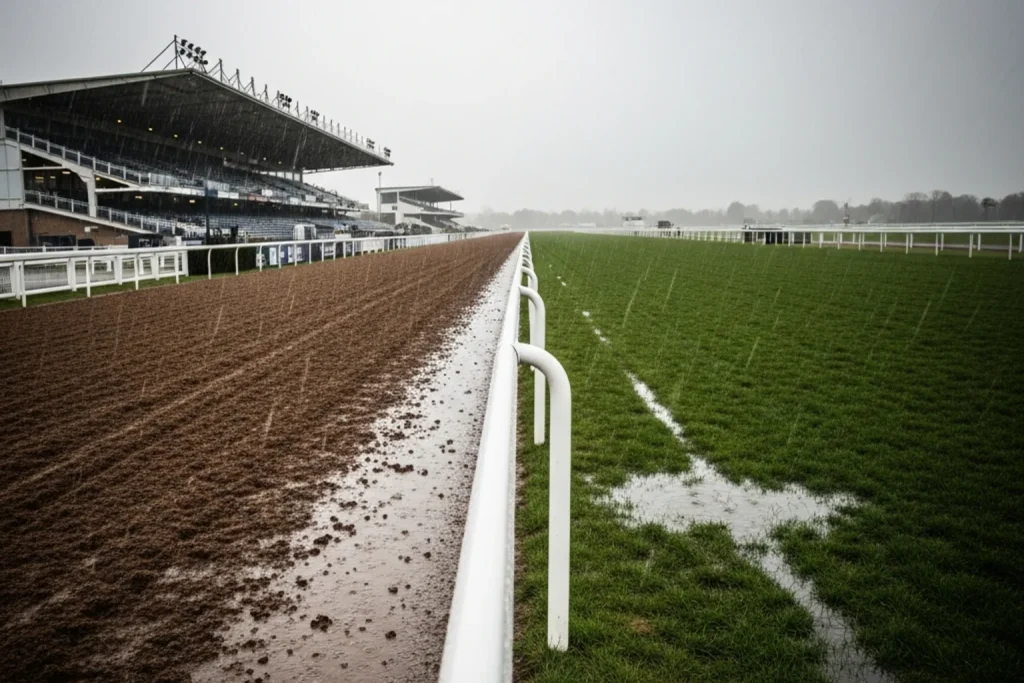
Measuring Weather Impact on Lingfield Track Conditions
At most British racecourses, the weather is the ultimate variable. Rain transforms the going. Frost threatens the fixture. Wind affects how horses travel around exposed bends. Every meeting is, to some degree, at the mercy of the sky above it. Lingfield Park is no exception — but it has an advantage that most courses do not. Its Polytrack all-weather surface was designed to neutralise the weather’s influence, and it does so with remarkable effectiveness.
That creates a split at Lingfield that is unique among British racecourses. On the AW circuit, weather is a footnote. On the turf course, it is the leading character. Understanding which track you are looking at — and what the weather means in each context — is the difference between reading conditions accurately and ignoring the most important variable on the card. Read the sky, then read the card.
Weather and the All-Weather: The Polytrack Advantage
Polytrack was engineered to be weather-resistant. The wax-coated quartz sand drains efficiently, the synthetic fibres maintain structural integrity in wet conditions, and the overall composition is designed to ride within a narrow band of consistency regardless of what is happening overhead. According to the manufacturer’s data, Polytrack surfaces reduce injury rates by approximately 50% compared to traditional dirt, and a significant portion of that safety advantage derives from the surface’s ability to maintain consistent properties in all weather.
Rain at Lingfield on an AW day is largely irrelevant to the racing. The surface absorbs and drains rainfall without becoming waterlogged or significantly changing the way it rides. A horse that performed well on Standard Polytrack in dry conditions two weeks ago faces essentially the same test on a rainy Tuesday this week. This consistency is what makes AW form at Lingfield so reliable from meeting to meeting — the going description almost never changes, which removes one of the biggest variables that punters on turf have to account for.
Cold weather is the one area where Polytrack is vulnerable. Prolonged sub-zero temperatures can stiffen the wax component of the surface, causing it to ride slightly differently — firmer and quicker than the standard going. In extreme cases, a sustained freeze can trigger a course inspection and, very occasionally, an abandonment. These events are rare in Surrey’s relatively mild climate, but they cluster in January and February when the AW programme is at its busiest. Monitoring the forecast during cold snaps is the one weather-related task that AW punters at Lingfield should not skip.
Heat, by contrast, has minimal impact. British summers rarely produce temperatures that stress the Polytrack surface, and the maintenance schedule — regular harrowing, periodic watering — keeps the surface within its operating parameters even during prolonged dry spells.
Weather and Turf: When the Going Gets Tough
On the turf course, the weather is everything. Lingfield’s turf programme runs from late spring to early autumn, and the going during that window is driven entirely by rainfall and temperature patterns. A dry May produces Good to Firm ground. A wet August produces Soft. The shift can happen within days, and when it does, the form book for the turf course is rewritten from scratch.
Draw bias at five and six furlongs on Lingfield’s turf course is described as massive in favour of high-numbered stalls, and that bias is directly influenced by the going. On firmer ground, the stands’ side of the track offers faster footing, amplifying the high-draw advantage. On softer ground, moisture evens out the surface across the width of the track, reducing the bias — sometimes significantly. A punter who checks the going and adjusts their draw analysis accordingly has a genuine edge over one who applies a fixed draw model regardless of conditions.
Rainfall between declaration and race time is a particular hazard on turf. A horse declared on the assumption of Good going may face Good to Soft or Soft by the afternoon if a weather front passes through. Trainers can withdraw their horses as non-runners in response to a going change, but punters who have already placed their bets at a fixed price are committed. Monitoring the hourly forecast on turf racedays at Lingfield — not just the morning report — is a discipline that protects against this scenario.
Wind is a lesser but still relevant factor. Lingfield’s tight, left-handed turf course has exposed sections where a strong headwind on the home straight can slow the pace and change the race dynamics. Horses racing prominently into a headwind tire more quickly, which can benefit hold-up runners who shelter behind the leaders until the final furlong. On still days, front-runners are harder to catch because they expend less energy holding their position.
Using Weather Forecasts in Your Race Assessment
The practical application of weather data in race assessment follows a simple workflow, but most punters do not bother with it — which is precisely why it offers an edge.
On the morning of a turf meeting, check the official going report on the BHA or racecourse website. Then check the weather forecast for the next six to eight hours. If rain is expected before the first race, the going is likely to ease. If the day is dry, the going will hold or may firm up slightly as the sun dries the surface. Cross-reference the forecast going with your assessment of each horse’s ground preferences. Horses that need fast ground in a race where rain is forecast become automatic downgrades. Horses that relish soft ground in the same scenario become upgrades.
On an AW day, the weather check is faster. Is there a frost risk? If not, you can largely set the weather aside and focus on form, draw, and trainer data. The one exception is extreme wind, which can affect race times and running styles even on the Polytrack — but this is a marginal factor, not a primary one.
Several weather services provide racecourse-specific forecasts that are more precise than generic regional forecasts. These factor in the local microclimate — Lingfield sits in a valley in the Surrey hills, which can trap moisture and produce localised conditions that differ from the broader area forecast. Using a racing-specific weather source rather than a generic app adds a layer of precision that pays for itself across a season of turf meetings.
The return on this discipline is cumulative. Any single weather check might change your assessment of one horse in one race. But across a season of Lingfield meetings — dozens of cards, hundreds of races — the aggregate effect of consistently factoring weather into your analysis is a measurable improvement in selection accuracy. It costs nothing but a few minutes each morning. The edge is free. Most people just do not collect it.
